You Had to Know Someone Just to Borrow a Book: The Class Divide That Libraries Erased Forever
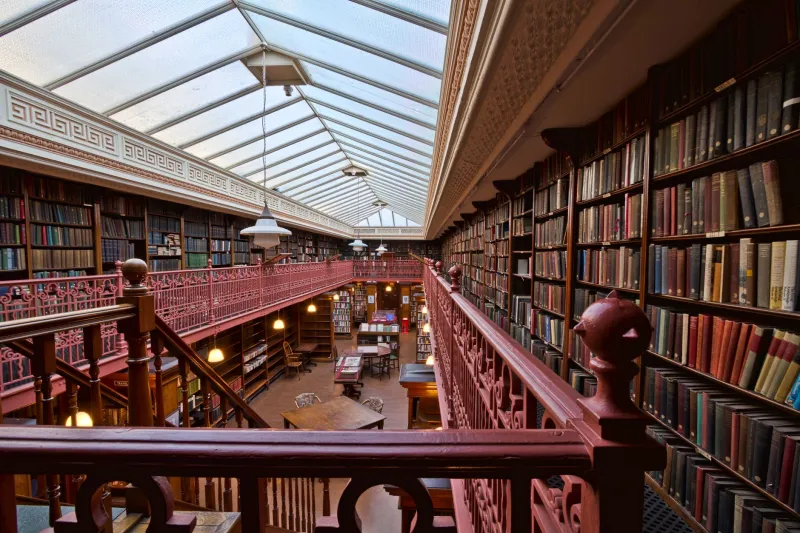
Think about the last time you walked into a public library. Maybe you grabbed a novel off the new arrivals shelf, logged into a computer, or downloaded an e-book without ever leaving your couch. It cost you nothing. Nobody asked for your credentials, your income, or your last name.
That experience — so ordinary it barely registers — would have been genuinely astonishing to most Americans living just 150 years ago. Because for most of this country's history, access to books wasn't a right. It was a privilege. And it came with a price tag.
Reading Was a Members-Only Affair
Before the public library movement took hold in the late 1800s, the primary way most Americans accessed books outside of personal ownership was through what were called social libraries or membership libraries — private lending clubs where annual dues bought you borrowing rights. In Boston, New York, and Philadelphia, these institutions were well-established, well-stocked, and well out of reach for anyone who wasn't solidly middle class or above.
The Boston Athenaeum, founded in 1807, required a proprietary share that cost $300 at a time when a skilled laborer might earn $1 a day. The New York Society Library charged annual fees that would make a working-class family think twice. These weren't public spaces with open doors. They were curated rooms for curated people — places where a man's reading habits said as much about his social standing as his address.
Mercantile libraries, aimed at young clerks and businessmen, were slightly more accessible, but still subscription-based. Mechanics' institutes offered reading rooms for tradesmen. Lyceums circulated books among their members. The system was fragmented, uneven, and entirely dependent on whether you happened to belong to the right group in the right city.
If you were a farmer in rural Ohio, a mill worker in Massachusetts, or a recently arrived immigrant in Chicago, the organized world of books was largely closed to you.
The Man Who Decided to Change That
Andrew Carnegie was born in Scotland in 1835 and arrived in America as a poor immigrant boy who understood, from personal experience, what it meant to be locked out of learning. As a young man in Pittsburgh, he'd been given access to a private library by a local benefactor — and he credited that access with fundamentally shaping the direction of his life.
When Carnegie became one of the wealthiest men in the world, he didn't forget that debt. Between 1883 and 1929, the Carnegie Corporation funded the construction of 2,509 libraries worldwide — 1,689 of them in the United States. Small towns across the country suddenly had elegant brick buildings filled with books that anyone could walk into and borrow, free of charge.
The conditions Carnegie attached were deliberate: the local government had to provide the land and commit to funding the library's ongoing operation. He wasn't handing out charity. He was building infrastructure. He was insisting that communities treat free reading as a civic responsibility, not a philanthropic luxury.
The effect was seismic. By the early twentieth century, the idea that a public library was simply part of what a town provided — like roads and schools — had begun to take hold across America in a way it never had before.
What It Actually Meant to Walk Through Those Doors
It's easy to underestimate how psychologically significant this shift was. For generations, the physical act of entering a building full of books had been a class-coded experience. The rooms were designed for people who belonged there. The librarians knew the members by name — because the members were a defined, vetted group.
When Carnegie libraries opened their doors to everyone, that changed the social texture of reading overnight. A twelve-year-old girl from a laborer's family could sit at the same reading table as a banker's son. A new immigrant could check out a book on American history, or civics, or grammar, without asking anyone's permission or paying anyone's fee.
Public librarians of that era often described being startled by the range of people who came through the doors in those early years — people who had never held a library card in their lives and weren't entirely sure what they were allowed to do once inside. The freedom was new enough to feel unfamiliar.
From Gatekeeping to Unlimited Access
Fast-forward to today, and the contrast is almost difficult to process. The average American with a library card — and library cards themselves are free — can access not just physical books but digital lending platforms like Libby and OverDrive, streaming audio through services like hoopla, academic databases, language learning tools, and in many cities, passes to local museums. All included. All free.
Beyond the library, the internet has made the sheer volume of freely available text essentially infinite. Project Gutenberg hosts tens of thousands of public domain books. Google Books has digitized millions of volumes. A person with a smartphone and a WiFi connection has more immediate access to more written material than the greatest private library in nineteenth-century America could have offered its wealthiest members.
The social library model — pay to read, belong to read — has been so thoroughly dismantled that it barely survives as a cultural memory. Most Americans under fifty have never lived in a world where borrowing a book required anything beyond a library card and the desire to read.
The Radical Idea We Stopped Noticing
There's something worth pausing on here. The public library system — free, open, universally accessible — was once a genuinely controversial proposition. Critics argued that giving working-class people access to books would breed discontent, encourage idleness, or simply go unused. Carnegie himself faced opposition from people who thought free libraries would undercut booksellers or create dependency.
Those arguments lost. And the result was one of the most quietly transformative social experiments in American history — a decision to treat knowledge as a public good rather than a private commodity.
The next time you download a library e-book at midnight without thinking twice about it, consider what that frictionless moment actually represents. Someone once had to fight for your right to do exactly that. And for most of American history, they would have lost.