The Notebook That Knew Everything You Owed: When Local Business Ran on Trust and Ink
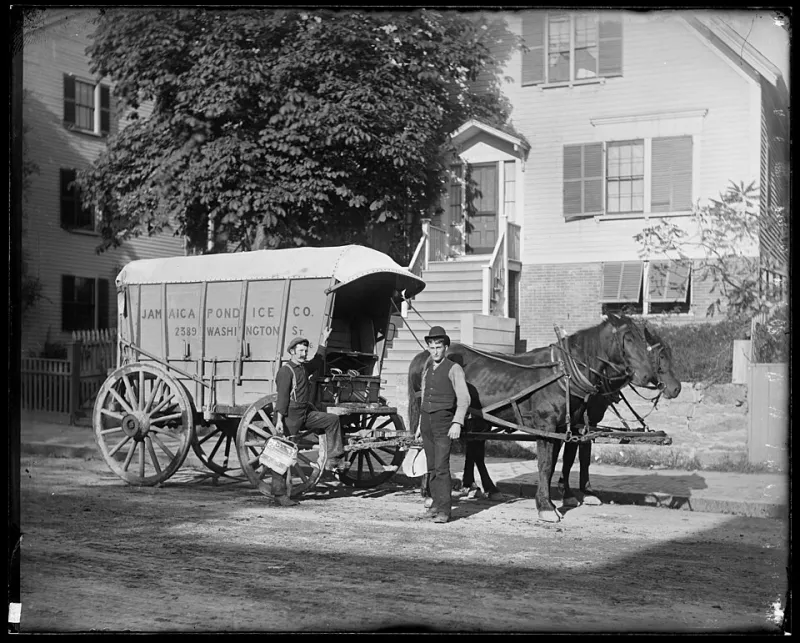
Picture this: It's February 1952, somewhere in working-class Philadelphia. The heating oil is running low and payday is still ten days out. You mention it to the man who delivers your coal, and without a contract, a credit check, or a second thought, he says he'll put it on the account. He writes your name and the amount in a small cloth-covered notebook he keeps in his breast pocket. You'll settle up at the end of the month. That's it. That's the whole transaction.
To modern eyes, this looks like a financial system built on wishful thinking. To the people who lived inside it, it was simply how commerce worked — and for decades, it worked remarkably well.
The Ledger Book Was the Database
Before point-of-sale terminals, before digital invoices, before the concept of a credit score existed in any meaningful form, the financial records of America's neighborhood businesses lived in handwritten ledgers. These weren't crude approximations of a proper system. They were the system.
The milkman tracked every household on his route — the number of bottles, the days of delivery, the occasional extra order of cream — in a running log he updated by hand. The corner butcher kept a tab for regular customers who couldn't always pay in full on the day. The dry goods store noted who owed what on ruled paper in a ledger that sat beside the register, consulted dozens of times a day.
These records were surprisingly accurate. The people who kept them had strong incentive to be precise — their livelihood depended on it — and many developed near-photographic memory for the details of their customers' accounts. The milkman didn't just know what you owed. He knew that you'd switched from whole milk to skim three weeks ago, that you'd added a weekly butter order in November, and that you always paid on the first Friday of the month without fail.
Credit Without a Contract
What made this system genuinely remarkable was the credit it extended, routinely and without documentation, to ordinary families.
In postwar America, working-class households often lived close to the edge of their income. The gap between a paycheck and a grocery bill could stretch wide in a bad week — a sick child, a broken appliance, an unexpected expense. Local merchants understood this because they were part of the same community. They knew who worked where, who had just had a baby, whose husband had been laid off. They extended credit not because a formula said the risk was acceptable, but because they personally judged the person across the counter to be good for it.
The terms were informal by today's standards but clear enough in practice. You paid when you could. You didn't abuse the arrangement. If you were going through a hard stretch, you said so, and often the merchant said fine, pay me when things ease up. The system held together because both sides understood that reputation was the collateral. A family that didn't pay its local accounts didn't just lose a vendor — it lost standing in the neighborhood, and that mattered enormously in communities where everyone knew everyone.
What Kept It Honest
It's worth asking how this didn't collapse into chaos. The answer is that community density did the work that legal contracts do today.
In a neighborhood where the same families had been shopping at the same stores for a generation, anonymity was almost impossible. If you skipped out on your account at the butcher, the butcher's wife told her sister, who mentioned it to her neighbor, who happened to be friends with your mother-in-law. Social consequences were swift, specific, and lasting. There was no fresh start, no moving to a new city and opening a new account. You lived with your reputation.
This isn't a romanticized picture — it had real costs. People who were genuinely struggling sometimes faced shame and pressure they didn't deserve. The system worked better for those who were already trusted and could be harder on newcomers, on minorities, on anyone who existed outside the established social web. The ledger book was only as fair as the person holding the pen.
But within its limits, it created a kind of economic intimacy that the modern financial system has never managed to replicate.
When the Database Arrived
The transition from handwritten ledger to computerized record-keeping happened unevenly across American business through the 1960s and 1970s, and it brought real improvements. Accuracy increased. Disputes became easier to resolve. Businesses could scale in ways that a single notebook could never support.
But something shifted in the relationship between merchant and customer. The record was now held by a system, not a person. Your account was a number in a file, not a name in a book that someone carried in their pocket. The intimate knowledge that once governed credit decisions — the butcher's personal assessment of your character — gave way to formulas and scores calculated by institutions that had never met you and never would.
Credit became more available in some ways and less flexible in others. You could borrow more money, but the person deciding whether to lend it had no idea who you were. The coal merchant who carried you through a hard winter because he'd known your family for fifteen years was replaced by a bank that extended or denied credit based on metrics you couldn't see or easily influence.
The Ledger's Legacy
The handwritten ledger book is essentially gone now, a relic of a commercial world that operated at human scale. What replaced it is more efficient, more consistent, and in many ways more fair. But it is not more personal, and it is not more forgiving.
The milkman who kept better records than your bank wasn't just tracking deliveries. He was maintaining a relationship — one built on daily contact, mutual dependency, and the kind of trust that accumulates slowly and matters enormously. When that relationship moved into a database, it didn't just change how accounts were kept. It changed what commerce meant.