The Army of Strangers Who Used to Keep Your House Alive
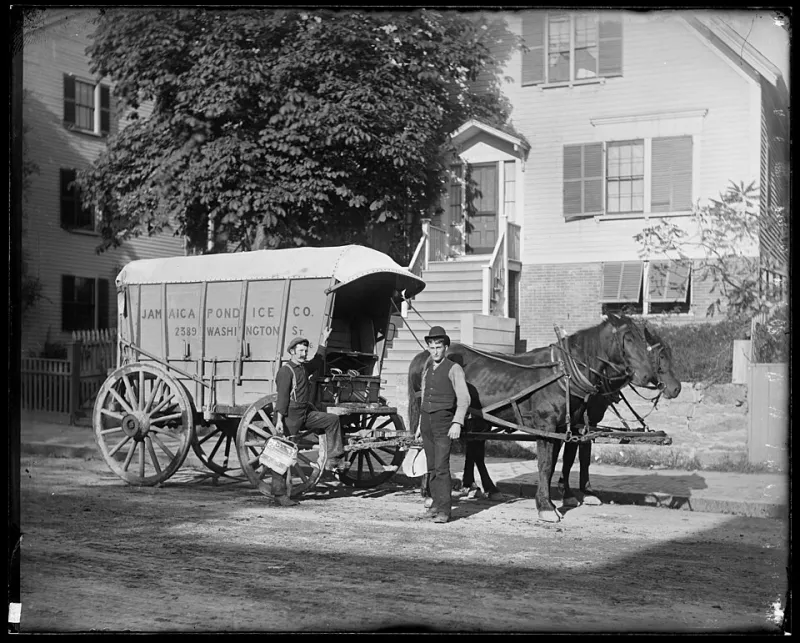
Photo: Currier, Charles Henry, 1851-1938, photographer, Public domain, via Wikimedia Commons
Think about everything that happens in your home on a typical day. The refrigerator hums. The furnace clicks on. Hot water arrives at the tap within seconds. The washing machine runs a full cycle while you're at work. None of it requires a single person to show up at your door.
Wind the clock back a hundred years, and that same list of household needs — keeping food cold, staying warm, having clean clothes, cooking a meal — required a small army of workers arriving on a rotating schedule, each one performing a specific job that no machine yet existed to replace. Your home didn't just run. It was maintained, by people, on foot, with deliveries and tools and a working knowledge of your family's particular needs.
That world is so thoroughly gone that it's almost impossible to picture. But it wasn't long ago.
The Morning the Iceman Came
Before mechanical refrigeration became affordable for ordinary families — which didn't happen widely until the late 1940s and into the 1950s — keeping food cold meant keeping actual ice in an actual icebox. And that ice had to come from somewhere.
The iceman was a daily or near-daily fixture in American neighborhoods from roughly the 1880s through the mid-twentieth century. He drove a horse-drawn wagon, later a truck, loaded with enormous blocks cut from frozen lakes or manufactured at commercial ice plants. Families would place a card in the front window — typically reading 25, 50, 75, or 100 — indicating how many pounds they needed that day. The iceman would read the card from the street, chip the right block, hoist it onto a leather pad on his shoulder, and carry it through the back door directly into the kitchen.
He knew which houses had narrow doorways. He knew which customers liked the ice placed a certain way. On hot summer mornings, kids in the neighborhood would trail behind the truck collecting chips of ice to suck on — a small, unofficial perk of his route that he tolerated with varying degrees of patience.
When the refrigerator finally arrived in American kitchens, it didn't just replace the icebox. It eliminated an entire profession almost overnight.
Coal Before the Click of a Thermostat
Heating a home in the early twentieth century meant coal. Specifically, it meant someone had to get that coal into your basement — and that was the coalman's job. He arrived seasonally but critically, usually in late summer or fall, to fill the coal bin that would fuel the furnace through winter.
The work was brutal and filthy. Coal was shoveled through a basement window chute, and the dust that accompanied each delivery settled over everything nearby. Families planned around it. Children were kept out of the basement for hours. The coalman himself arrived blackened and left the same way.
But he was essential. Without him, you didn't get through January.
Natural gas and oil heating systems, which expanded dramatically through the postwar decades, made coal delivery obsolete in most American cities. The furnace became something you set and forgot. The coalman became a figure in old photographs.
The Weekly Visitors
Coal and ice were the big ones, but they weren't alone. The rhythm of a household in 1920 or 1930 involved a rotating cast of specialized workers appearing at the door on predictable schedules.
The knife sharpener pushed a cart or rode a bicycle fitted with a grinding wheel, announcing his presence with a bell or a distinctive call. Housewives would bring out kitchen knives, scissors, and sometimes garden shears. He'd sharpen them on the spot for a few cents each and move on down the block.
The ragman came through collecting old clothes, rags, and scrap metal — the original curbside recycling program, driven by economics rather than environmentalism. What he collected was sold to manufacturers who turned it back into usable material. Nothing was wasted because nothing could afford to be.
The milkman is perhaps the most remembered of this group, partly because he survived longest. Home milk delivery persisted in some American cities well into the 1970s, and a handful of operations still exist today. But in his heyday, the milkman arrived before sunrise, left glass bottles on the porch, collected the empties, and sometimes left notes back and forth with customers about what they needed the following week. It was commerce conducted through handwriting on small pieces of paper tucked inside bottle caps.
What All Those Visits Actually Meant
The practical argument for appliances replacing all of these workers is overwhelming. Refrigerators don't take days off. Furnaces don't track mud through the kitchen. Washing machines don't require scheduling. The efficiency gains were enormous and real, and they freed up time — particularly for women, who bore the primary burden of coordinating all of these arrivals — in ways that genuinely mattered.
But there was something embedded in all that human traffic that didn't survive the transition.
Neighborhoods knew themselves differently when a dozen workers moved through them every week. The iceman knew which families were struggling. The milkman noticed when a bottle sat uncollected. These weren't social workers — they were tradespeople doing a job — but they formed an informal web of awareness that meant households weren't entirely invisible to the world around them.
Today, an app schedules a delivery drone. A smart thermostat adjusts the heat. A subscription service refills whatever runs out. The house runs beautifully, and almost no one comes to the door.
The efficiency is real. So is the quiet.