Ping-Pong, Pool Tables, and the Basement That Held the Whole Family Together
Ask anyone who grew up in an American suburb between the 1950s and the 1980s about their basement, and watch their face change. There's almost always a story. A ping-pong table that doubled as a homework surface. A pool table that nobody was quite good enough to justify owning but everybody loved anyway. A dart board on the wall, a bar cart in the corner, maybe a record player or a foosball table that got knocked over during an argument and never quite sat level again.
The American basement — or the finished family room, in houses without one — was once a genuine institution. It was where the neighborhood kids ended up on a rainy Saturday. Where teenagers were allowed to be loud. Where parents could relax without worrying about the good furniture. It was chaotic, communal, and almost entirely analog. And it's mostly gone now, replaced by something quieter and more solitary that we've somehow convinced ourselves is better.
When Fun Was Something You Built
The postwar housing boom of the late 1940s and 1950s gave millions of American families something they'd never had before: space. Suburban homes came with basements, garages, and back yards — square footage that needed to be filled. And the consumer economy was ready with answers.
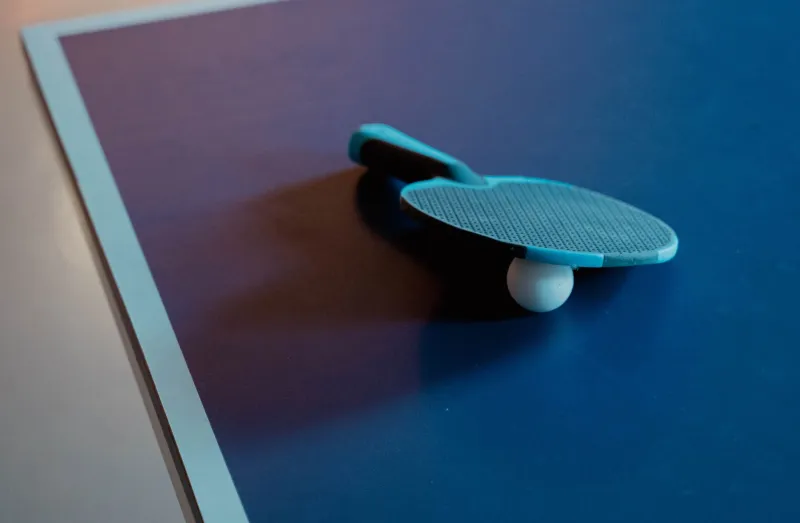
Ping-pong tables became a middle-class staple. Pool tables, once associated with smoky billiard halls and questionable company, were rebranded as wholesome family entertainment and moved into the home. Dart boards, air hockey tables, pinball machines, shuffleboard — the basement became a kind of private arcade, built piece by piece over years of birthdays and Christmases.
Some families went further. Home darkrooms for photography were surprisingly common among hobbyist dads in the 60s and 70s. Craft rooms. Workshop spaces with lathes and band saws. Ham radio setups. Model train layouts that consumed entire corners of the basement and years of careful assembly. These weren't just hobbies — they were worlds built inside the house, shared across generations.
The key detail is that all of it required other people to be any fun at all. You can't play ping-pong alone. Pool requires a partner. Darts is better with three. The basement was social infrastructure disguised as recreation.
The Neighborhood That Came Through the Side Door
What made the basement era genuinely distinctive wasn't just the equipment — it was the culture around it. Neighborhood kids didn't need an invitation. They showed up, knocked, and were waved downstairs. Parents knew roughly where everyone was because the noise told them. Kids from three different families might spend an entire Saturday afternoon in one basement, cycling through games, arguing about the rules, getting bored, inventing new games, getting bored again.
Boredom was actually part of the deal. There were only so many times you could play the same game before you had to get creative. Kids built obstacle courses out of old furniture. They invented elaborate tournaments with hand-drawn brackets. They got into minor trouble and figured their way out of it. The limited options forced imagination in ways that unlimited options simply don't.
For parents, the basement served a different function. It was a place to entertain other couples without the evening becoming a formal production. Card tables came out. Drinks were poured. The kids disappeared downstairs and the adults had a few hours of something resembling a social life without hiring a babysitter or leaving the house.
How the Screen Quietly Dismantled All of It
The first television sets were already in living rooms by the early 1950s, but they were communal by necessity — one screen, one room, everyone watching the same thing together. Even that early, passive version of screen entertainment still gathered the family in one place.
The fragmentation came later and gradually. Cable television brought more channels, which meant more disagreements about what to watch, which meant the logical solution was more televisions. By the 1990s, kids having TVs in their bedrooms was common enough that it stopped being remarkable. Then came the computer, and then the laptop, and then the smartphone, and then the tablet, and somewhere in there the basement stopped being the obvious answer to the question of what to do on a Saturday afternoon.
Today, the average American household has more screens than people. Entertainment is instant, infinite, and almost entirely individual. A family of four in the same house on a Sunday evening might be watching four completely different things in four completely different rooms, each perfectly satisfied with their own selection. By almost any measure of content quality, they're better off than the family that had three channels and a ping-pong table. But they're also, in a meaningful sense, alone together.
What the Pool Table Actually Gave You
It would be easy to romanticize the basement era beyond what it deserves. Those spaces were also loud, occasionally dangerous, and frequently the site of sibling conflict that escalated well beyond what the dart board was designed to handle. Not every family had the money or the space to build a dedicated recreation room. And plenty of kids would have traded the ping-pong table for a personal television without a second thought.
But the forced togetherness of that era produced something that's harder to engineer today: shared experience. When you only have one game and four people who want to play it, you negotiate. You wait your turn. You learn how your brother handles losing and how your neighbor's dad handles winning. You spend time with people you didn't choose, in proximity close enough to actually know them.
The basement wasn't just entertainment. It was practice for being around other people — practice that happened automatically, without anyone planning it, because the architecture of the house and the limits of the technology left no other option.
We've gained extraordinary freedom in how we spend our leisure time. But the old basement, with its scuffed floor and its slightly warped ping-pong paddles, gave us something that algorithms and streaming queues haven't found a way to replace.