The Man Behind the Counter Who Knew Your Whole Medical History
Photo: Steve Shook from Moscow, Idaho, USA, CC BY 2.0, via Wikimedia Commons
Somewhere between the rise of the chain pharmacy and the invention of the automated pill dispenser, something quietly slipped away. It wasn't dramatic. There was no announcement. But the person who once stood between you and a potentially dangerous drug combination — who knew your mother took blood thinners and that your youngest was allergic to penicillin — gradually became a voice on a phone tree, then a screen, then nothing at all.
For most of American history, the neighborhood pharmacist was something closer to a second doctor. And in many ways, they were more accessible than the first one.
The Counter Was an Office
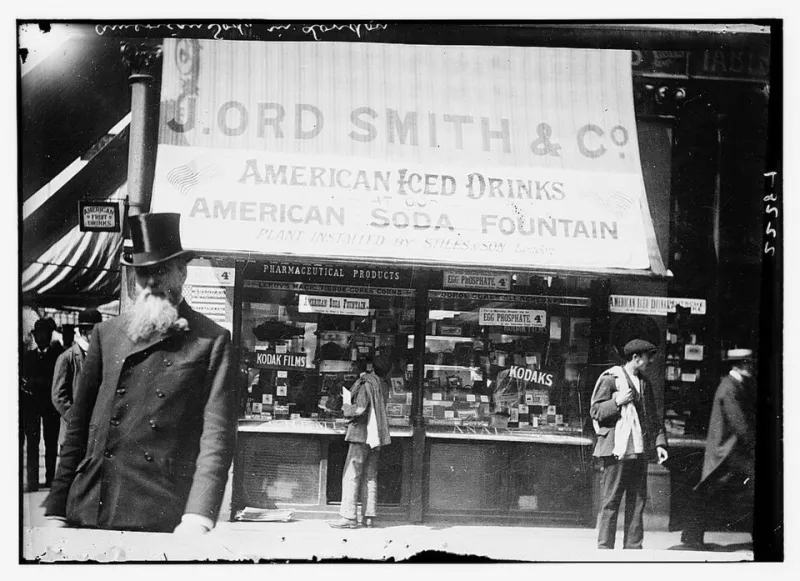
In the mid-twentieth century, most American towns had an independent drugstore. Not a chain. Not a big-box pharmacy tucked inside a superstore. A single storefront, often family-owned, where the pharmacist behind the wooden counter had likely filled prescriptions for your parents and would eventually fill them for your kids.
These weren't just pill counters. They were trained professionals who, by necessity and by culture, functioned as front-line medical advisors. When a doctor scrawled something illegible on a prescription pad — and those handwritten scripts were genuinely difficult to decode — the pharmacist was the last line of defense before that medication reached a patient. They called the doctor's office. They asked questions. They slowed things down when slowing down mattered.
More than that, they remembered. Not through a database. Through actual memory and a handwritten card index that tracked your household's medications going back years. If your new prescription conflicted with something you'd been taking since 1958, they'd catch it — not because a computer flagged it, but because they knew.
More Than Filling Orders
The conversation that happened at the pharmacy counter in 1955 would be almost unrecognizable today. Pharmacists routinely explained dosages in plain language, asked whether patients had eaten, warned about side effects that doctors hadn't mentioned, and sometimes gently suggested a follow-up visit when something in a prescription didn't sit right with them.
For working-class families who couldn't afford frequent doctor visits, this guidance was genuinely critical. The pharmacist was often the first person a mother called when her child had a fever, or the person a retiree checked with before mixing a new supplement with his heart medication. They occupied a trusted space in community life that wasn't quite medical and wasn't quite social — it was something in between, and it worked.
Many pharmacists also compounded medications on-site, mixing custom formulations for patients whose needs didn't fit a standard commercial product. That skill — part science, part craft — meant they understood drugs at a molecular level that translated into real-world patient conversations. They weren't reading from a package insert. They knew.
When Efficiency Rewrote the Role
The consolidation of American pharmacy into national chains began accelerating through the 1980s and 1990s. The economics made sense on paper: centralized purchasing, standardized processes, high volume. What got harder to quantify was the relationship.
Chain pharmacies brought genuine benefits — longer hours, lower prices, more locations. But they also brought something else: throughput pressure. Pharmacists in large retail settings began filling dozens, then hundreds of prescriptions per shift. The time available for each patient shrank. The expectation of a conversation quietly disappeared.
Today, millions of Americans refill prescriptions through an app, receive a text when their order is ready, and pull through a drive-through window to collect a paper bag without exchanging a single word with a human being. Automated kiosks in some locations allow patients to pick up medications entirely independently. The system is fast. It is often accurate. What it is not is personal.
What the Algorithm Doesn't Know
Modern pharmacy software does flag drug interactions — and that's genuinely valuable. But software flags interactions based on what's in the system. It doesn't know that you've been under unusual stress lately, or that you mentioned last month you'd been skipping doses because of the cost, or that your elderly father picks up his own prescriptions and sometimes gets confused about which bottle is which.
A pharmacist who knew your family knew all of that. And they factored it in, without being asked.
There's also something worth noting about the texture of those interactions. Picking up medication for a serious diagnosis is not a neutral experience. It can be frightening. Having someone look you in the eye, explain what you're holding, and tell you what to watch for — that wasn't just medically useful. It was humanly useful. It made a hard moment slightly less hard.
A Safety Net That Quietly Dissolved
Nobody made a decision to eliminate the neighborhood pharmacist. It happened the way most cultural losses happen — gradually, through a thousand small economic choices that each made individual sense but added up to something significant.
What replaced that relationship is more efficient by almost every measurable standard. Prescriptions are filled faster. Prices are often lower. Access has expanded in real ways. These are not small things.
But somewhere in the optimization, the human layer got thin. The person who once stood between a confused patient and a dangerous mistake — who knew your name, your history, and sometimes your face before you even reached the counter — became a job title rather than a relationship.
That's worth remembering, even if there's no going back.