The Man Behind the Counter Who Knew More About You Than Your Doctor Did
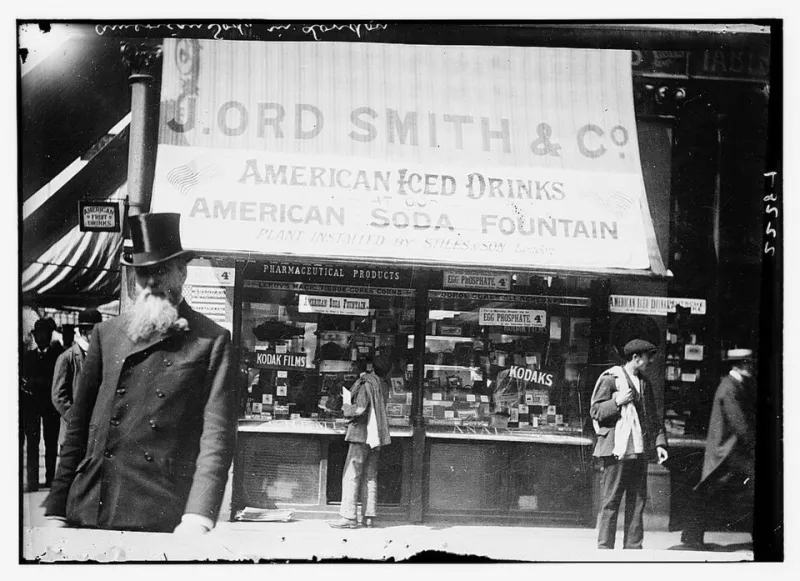
Photo: The Library of Congress, No restrictions, via Wikimedia Commons
Somewhere in a desk drawer, your grandfather probably kept a small brown bottle with a hand-typed label. The pharmacist's name was on it — not the chain store's logo, not a toll-free number for refills. Just a name. Maybe the same name that had been filling prescriptions for your family since before your father was born.
That wasn't a small thing. That was a safety net most of us have completely forgotten existed.
The Note That Started Everything
Before electronic prescribing, before pharmacy benefit managers, before the automated voice that calls to tell you your pills are ready, there was a piece of paper. A doctor — your doctor, the one who had examined you that morning — would pull out a prescription pad and write in longhand. The notation was often nearly illegible to anyone outside the profession, a kind of shorthand that only a trained pharmacist could reliably decode.
You'd carry that slip of paper across town, hand it over the counter, and wait. Sometimes you'd sit in a chair by the window. Sometimes you'd come back in an hour. Either way, what happened next was far more involved than most patients realized.
The pharmacist didn't just count pills. They read that prescription against everything they already knew about you. They cross-referenced it against the other medications you were taking. They thought about whether the dosage made sense for someone your size. And if something seemed off, they picked up the phone and called your doctor directly — not a call center, not a digital flag in a system. A conversation between two professionals who both knew you by name.
A Living Medical Record, Kept in a Person's Head
The neighborhood pharmacist of mid-century America was, in many ways, a walking database of community health. Before HIPAA, before electronic health records, before any of the infrastructure we now take for granted, the local druggist simply remembered things.
They knew that Mrs. Henderson down on Maple was allergic to sulfa drugs. They knew that Mr. Kowalski's blood pressure medication shouldn't mix with the over-the-counter painkiller he'd been buying every few weeks. They knew which families struggled to afford their medications and which ones needed a gentle reminder to finish a full course of antibiotics.
This wasn't formal record-keeping in the modern sense. It was accumulated knowledge, the kind that lives in a person rather than a server. And while it was imperfect — it depended entirely on one individual's memory and attentiveness — it created a layer of protection that no algorithm has fully replicated.
Studies in recent years have found that adverse drug interactions remain a leading cause of preventable hospitalizations in the United States. The systems we've built are sophisticated. But they don't always catch what a careful human being, paying close attention over years, would have noticed immediately.
When Getting Your Medicine Was a Conversation
There's something worth pausing on here: the act of picking up a prescription used to involve talking to someone.
Not reading a pamphlet. Not watching a sixty-second animation on a pharmacy app. Talking. The pharmacist would often explain what the medication was for, how to take it, what to watch out for. They'd ask if you had questions. And because they knew you, they'd sometimes offer information you hadn't thought to ask for.
"With your blood pressure, you'll want to watch the sodium in your diet while you're on this." That kind of remark — informal, personal, rooted in relationship — carried real weight. It came from someone who had context. Someone invested.
Today, the average American fills their prescriptions at one of roughly 60,000 retail pharmacy locations, many of them attached to grocery stores or big-box retailers. Pharmacists at these locations are often processing hundreds of prescriptions a day under significant time pressure. The counseling still happens — it's legally required — but the depth of it has changed. It can't help but change when the relationship behind it no longer exists.
The Rise of the Drive-Through and the Mail-Order Bottle
The shift didn't happen overnight. It followed the broader arc of American retail — consolidation, efficiency, scale. Independent pharmacies, which once anchored nearly every main street in the country, began closing as chain stores offered lower prices and longer hours. By the 1990s, the trend was well underway. By the 2010s, mail-order pharmacy had added another layer of distance.
The mail-order model makes undeniable sense for people managing chronic conditions on stable, long-term medications. It's convenient. It's often cheaper. A ninety-day supply arrives at your door without you ever having to leave the house. During a pandemic, that convenience became something close to essential.
But convenience has a cost that doesn't show up on the invoice. When your medication arrives in a padded envelope from a fulfillment center in another state, there is no one on the other end who knows you. There is no relationship. There is no accumulated knowledge of your history quietly working on your behalf.
What We're Still Figuring Out How to Replace
The irony of modern pharmacy is that we now have access to more information than any neighborhood druggist could have dreamed of — digital interaction records, AI-assisted screening tools, comprehensive allergy alerts — and yet patients routinely fall through the cracks in ways that a single attentive human being might once have prevented.
Some independent pharmacies have survived, and in communities where they still exist, their value is increasingly recognized. Patients who use them often describe the experience in terms that sound almost quaint: the pharmacist remembered that they'd had a bad reaction to a similar drug two years ago. The pharmacist noticed they'd stopped refilling a critical medication and called to check in.
That's not nostalgia. That's healthcare.
The handwritten prescription is essentially gone. The neighborhood pharmacist who knew three generations of your family is increasingly rare. What replaced them is faster, more scalable, and in many ways more technically sophisticated. But somewhere in that transaction, something quietly left the building — and we're still working out exactly what it was worth.