One Shot, One Chance: The Discipline That Film Photography Burned Into a Generation
Somewhere in a shoebox in your parents' house — or maybe in yours — there's a photograph that should never have been kept. Someone's eyes are closed. The horizon is tilted at a disorienting angle. Half of Aunt Carol is missing because whoever held the camera misjudged the frame. And yet there it is, preserved for decades, because throwing away a developed photograph felt wasteful in a way that's almost impossible to explain to anyone who grew up with a smartphone.
Film was finite. Film cost money. And once you pressed the shutter, that was it.
The economics of photography before the digital era shaped an entire relationship with image-making that we've almost entirely forgotten. Understanding it isn't just a trip down nostalgia lane — it reveals something genuinely interesting about how consequences change behavior, and what we trade away when we eliminate them.
The Math That Made You Think Twice
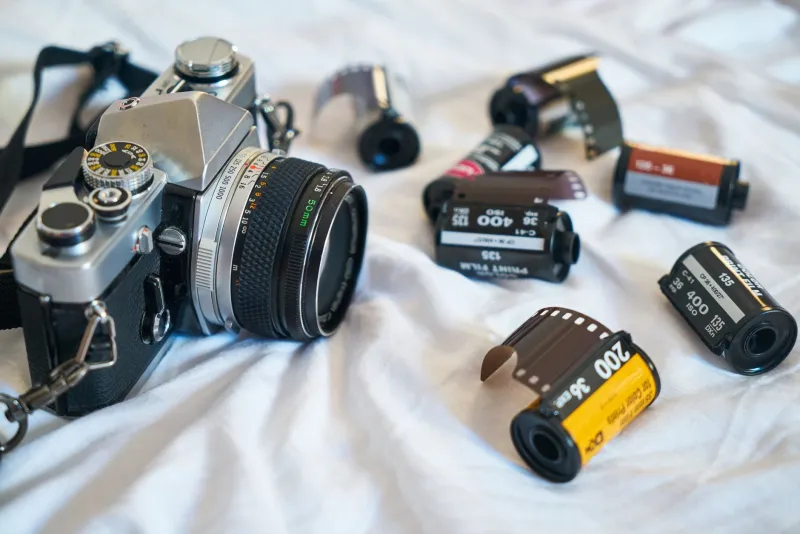
In the mid-1990s, a standard roll of 35mm film gave you 24 or 36 exposures. The film itself cost a few dollars. Development and printing added several dollars more — often $8 to $15 at a one-hour photo lab, depending on print size and location. If you shot two rolls on a family vacation, you were looking at $25 to $35 just to find out what you'd captured.
That's not a staggering sum, but it was enough to make you pause. Before pressing the shutter, you thought: Is this worth it? Is the light good enough? Is everyone looking at the camera? Did I already take basically this same shot?
That pause was everything.
It created a kind of photographic discipline that wasn't taught so much as enforced by cost. Amateur photographers learned — often through expensive mistakes — to read light, to check the frame, to wait for the right moment rather than firing off ten shots and hoping one worked. The feedback loop was brutal: you wouldn't know you'd missed the shot until you picked up your prints at the drugstore three days later, by which point the vacation was over and the moment was irretrievably gone.
The Ceremony of Getting Your Photos Back
That three-day wait deserves its own moment of attention, because it was genuinely unlike anything in modern life.
You'd drop off your film. You'd get a little paper receipt with a pickup date. And then you'd go about your life, carrying a kind of low-level anticipation that's hard to describe — somewhere between excitement and anxiety. Had you nailed the shot of the kids at the Grand Canyon? Was the birthday party captured well, or had you accidentally left the lens cap on for the first six frames? (It happened. More than once. To more people than would care to admit it.)
Pickup day had a ritual quality to it. You'd flip through the envelope right there at the counter, or more likely in the car before you even started the engine. The good ones made you genuinely happy. The blurry ones, the closed eyes, the missed moments — those stung in a specific way, because there was no second chance. That version of that moment was gone.
What this created, over time, was a curated record. Not curated in the Instagram sense of filters and careful framing, but curated by scarcity. You didn't have 4,000 photos from your 1994 trip to Disney World. You had 48, maybe 72 if someone brought two rolls. And every single one of them was there because someone decided it was worth a frame.
The Liberation of Delete
Digital cameras arrived gradually through the late 1990s and early 2000s, and the shift they enabled was genuinely revolutionary. Suddenly, the cost of a bad photograph was zero. You could shoot the same scene thirty times and delete twenty-nine of them without a second thought. The feedback was instant — you could check the screen immediately and reshoot if the result wasn't right.
For professional photographers, this was transformative in ways that are almost impossible to overstate. Sports photographers could capture entire sequences and choose the peak moment. Portrait photographers could experiment with lighting without burning through film. The floor of what was technically achievable by an amateur rose dramatically.
For everyday users, the freedom was intoxicating. Road trips that would have produced one roll of film now generated hundreds of images. Events that used to yield a careful dozen shots became archives of thousands. The anxiety of the missed moment largely disappeared, replaced by the confidence that somewhere in the burst, one image would be good enough.
What Abundance Quietly Changed
But something shifted alongside the liberation, and it's worth sitting with.
When photographs became infinite and free, the act of taking one changed character. The pause before pressing the shutter — the moment of genuine consideration — shortened dramatically, and then for many people disappeared entirely. Why think carefully when you can just take ten shots?
More subtly, the relationship between experience and documentation started to blur. Film photographers were constrained enough that they mostly had to live the moment and document it selectively. Digital abundance made it easier to spend a concert, a sunset, or a child's first steps primarily behind a screen, capturing rather than experiencing.
There's also something to be said about memory. Psychologists have found that the act of photographing something can actually reduce how well we remember it — the brain, in a sense, outsources the memory to the device. When photographs were rare, the ones you didn't take stayed with you differently. The uncaptured moments had to be remembered the old-fashioned way.
None of this is an argument for going back to film, or for pretending that expensive, slow, uncertain photography was better in any objective sense. It wasn't. Digital photography democratized an art form and gave ordinary people creative tools that professionals would have envied a generation earlier.
But the shoebox matters. The blurry Aunt Carol matters. They're proof that imperfect, finite, consequence-laden photography produced something that all the storage in iCloud can't quite replicate: a small, deliberate, irreplaceable record of what someone thought was worth remembering.
And sometimes, the discipline of limits makes you better at the thing itself.