The Grocer Who Knew Your Business: When Your Weekly Shop Revealed Everything About You
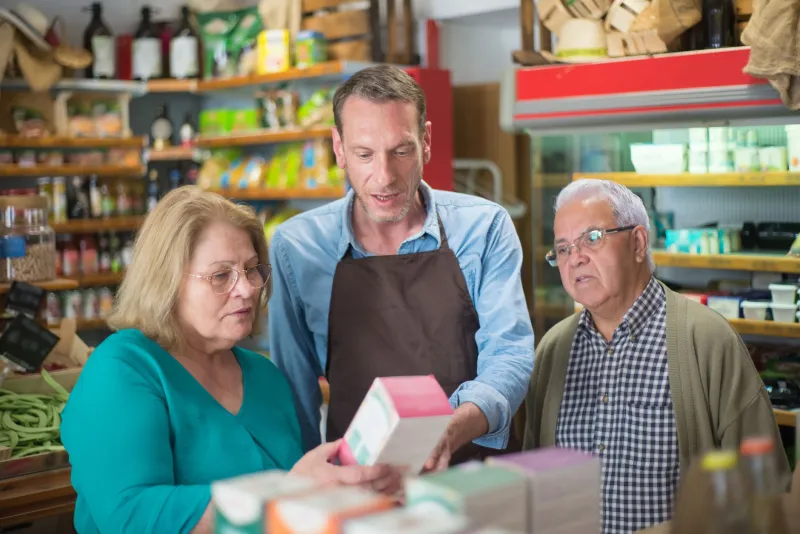
Every Thursday morning in 1955, Margaret Hollis walked three blocks to Dempsey's Grocery on the corner of Elm and Fourth. She didn't bring much cash. She didn't need to. Ray Dempsey would pull out her account card, tally up her order, and add it to the running balance she'd settle at the end of the month. He knew she bought extra butter the week before Christmas. He knew her oldest son had started buying cigarettes. He knew when the family was cutting back, because the cuts showed up in the cart.
Ray Dempsey wasn't a spy. He was just a grocer who paid attention. And in mid-century America, that's exactly what grocers did.
The Neighborhood Store as Social Mirror
Before the interstate highway system made suburban supermarkets viable, before refrigeration technology allowed large-scale food storage, and before the automobile made it practical to shop in bulk once a week, most American families bought their groceries in small quantities from local stores they could walk to. These weren't the impersonal aisles of a modern supermarket. They were small, staffed operations where clerks pulled items from shelves behind the counter and assembled your order while you waited.
This setup meant that every transaction was a human interaction. You didn't browse anonymously. You told the clerk what you needed, and they got it for you. If they'd been serving your family for years, they often knew what you needed before you asked.
The social dimension of this was enormous. Your grocery list was a window into your household. What you bought, how often you bought it, and how much you spent told the story of your family's size, income, health, habits, and circumstances. A family buying less meat than usual was probably having a hard month. A household suddenly stocking up on baby formula was expecting an addition. A customer switching from name brands to generics was feeling financial pressure they might not have mentioned to anyone.
Credit, Trust, and the Account Card
The credit relationship between grocer and customer was one of the defining features of neighborhood food retail in America through the mid-twentieth century. Store accounts — where customers bought on credit and settled weekly or monthly — were standard practice in many communities, particularly in working-class and rural areas.
This wasn't the impersonal credit of a bank or a department store charge card. It was a relationship built on years of acquaintance and mutual reliability. The grocer extended credit because he knew your family, knew your employer, knew your reputation in the neighborhood. The customer paid promptly because the grocer was a neighbor, not a corporation.
That relationship created a form of accountability that ran in both directions. If you fell behind on your account, Ray Dempsey wasn't going to send a collections notice. He was going to see you at church on Sunday. Social pressure and genuine community connection did the work that credit scores and interest rates do today.
But it also meant that your financial struggles were visible in a way that modern anonymous commerce has largely eliminated. The grocer who extended you credit knew you needed it. That knowledge carried its own quiet weight.
The Clerk Who Remembered You Preferred the Good Tomatoes
One of the most striking aspects of the old neighborhood grocery model was the degree of personalization it offered — not through an algorithm, but through genuine human memory and attention.
A good grocery clerk in 1950 knew that Mrs. Patterson was particular about her produce and always wanted to choose her own tomatoes. He knew that Mr. Kowalski bought kielbasa every Friday without fail. He knew which families were Catholic and adjusted their fish suggestions during Lent accordingly. He knew who was on a budget and who wasn't, and he'd quietly steer people toward the better value without making anyone feel embarrassed.
This kind of personalized service required no data infrastructure, no recommendation engine, no loyalty card program. It required only continuity — the same people, serving the same customers, over years and decades.
The modern equivalent of this is the algorithmic recommendation system: the grocery app that notices you buy oat milk and suggests a related product, or the loyalty program that tracks your purchasing patterns and sends you coupons calibrated to your habits. The data is more detailed and the scale is vastly larger, but the underlying logic is the same: knowing what you buy tells us something about who you are.
The difference is that in 1955, that knowledge lived in a human mind and stayed in the neighborhood. Today, it lives in a corporate database and travels wherever the terms of service allow.
The Supermarket and the End of Knowing
The rise of the American supermarket — which accelerated dramatically in the 1950s and 1960s — changed the grocery experience in ways that went far beyond product selection and parking. It industrialized the shopping experience and, in doing so, anonymized it.
Self-service aisles meant you no longer had to speak to a clerk to shop. Cash transactions meant no account, no running balance, no relationship. Scale meant no single employee could know more than a fraction of the customers who passed through on any given day.
For many shoppers, this was a relief. The neighborhood grocer's knowledge could feel intrusive. The freedom to browse anonymously, to make choices without commentary, to have a bad financial month without anyone in the neighborhood noticing — these were genuine gains. Privacy, it turned out, was something a lot of Americans had been quietly wanting.
Two Ways of Being Known
What's striking, looking back, is that we've essentially rebuilt the data-collection capacity of the old neighborhood grocer — just without the human warmth. Your grocery loyalty card, your delivery app, your store brand credit card: together they know more about your eating habits than Ray Dempsey ever did. They just don't know your name the way he did. They don't ask about your mother's health or remember that you like the good tomatoes.
We traded one kind of being known for another. The old way was personal, local, and embedded in community. The new way is comprehensive, impersonal, and embedded in a privacy policy nobody reads.
Which version served us better is a question worth sitting with the next time you scan your loyalty card at the checkout — alone, unrecognized, efficiently served.