One Good Suitcase, Ten Days, No Complaints: When Packing Light Was Just How You Traveled
In 1962, a family of four from suburban Ohio drove to Florida for two weeks. The father packed one medium suitcase. The mother packed one. The two kids shared another. That was it. Three bags for four people for fourteen days, loaded into the trunk of a Buick with room left over for a cooler and a road atlas.
Nobody on that trip posted a photo of their outfit. Nobody packed a backup look for the beach. The kids wore the same shorts three days running. The father wore the same slacks to dinner every night, and the mother rotated between two dresses she'd pressed carefully before leaving home.
It was a vacation. It was also, by today's standards, an act of radical minimalism.
The Suitcase That Was Built to Outlast You
Before we talk about what was packed, it's worth talking about what it was packed in — because the luggage itself tells the story.
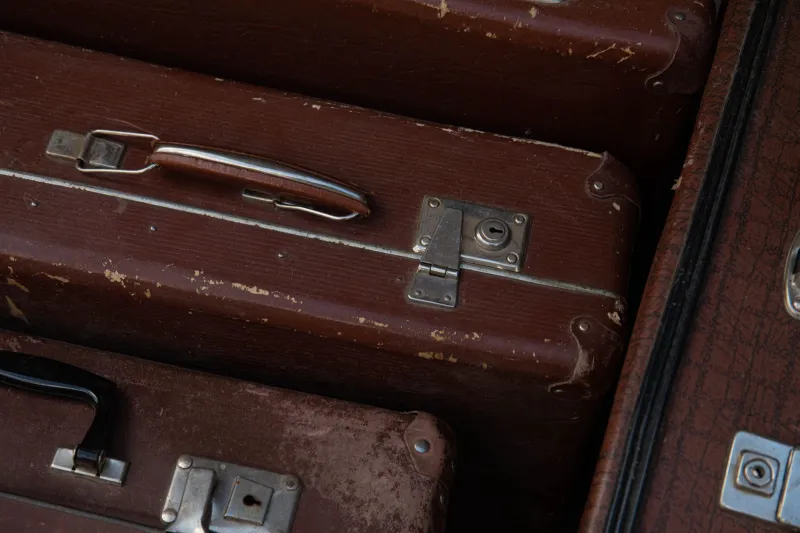
For most of the twentieth century, a good suitcase was a serious investment. Brands like Hartmann, Samsonite's higher-end lines, and various leather goods makers sold bags that were built to last decades. They were heavy, yes — rigid shells, brass hardware, reinforced corners. But they were also genuinely indestructible. People inherited luggage from their parents. They brought the same bag on their honeymoon and on their 25th anniversary trip.
Luggage was purchased once, maybe twice in a lifetime, and treated accordingly. It got monogrammed. It got repaired when the latch broke, rather than replaced. It was, in the truest sense, an investment piece — the kind of thing you thought about before you bought it because you knew you'd be living with your choice for a very long time.
Walk through any airport today and you'll see a sea of identical hard-shell spinners in colors chosen to stand out on a baggage carousel. Most of them are cheap enough to replace after two or three trips. Many of them will be.
Dressing for the Trip, Not the Feed
The shift in how Americans pack isn't just about luggage quality. It's about a fundamental change in what travel is supposed to look like — and who it's supposed to look like that for.
In the mid-twentieth century, people dressed for travel itself. Getting on an airplane was a formal occasion. You wore your good clothes. Once you arrived, you had your "vacation clothes" — a specific, limited wardrobe selected for the trip — and you wore them, repeatedly and without embarrassment, for the duration.
The idea that you needed a different outfit for every day, let alone every activity, would have struck most Americans of that era as genuinely bizarre. Clothes were expensive relative to income. You took care of them. You rewore them. You mixed and matched deliberately, the way people who actually think about their wardrobe still do.
Social media changed the math entirely. When every moment of a trip is potentially photographable and shareable, being seen in the same outfit twice feels, to many travelers, like a kind of failure. The result is overpacking on a scale that would have baffled previous generations — checked bags stuffed with options, backup options, and options for the options.
Fast Fashion Made It Worse
The rise of fast fashion in the 1990s and 2000s made overpacking dramatically cheaper and, therefore, dramatically more common. When a new top costs $12 and a pair of vacation shorts costs $18, the mental calculation changes. Why pack carefully when buying something new at the destination is barely more expensive than checking a bag?
This disposability extended to vacation wardrobes specifically. "Vacation clothes" became a category of fast-fashion purchases — things bought for a trip, worn once or twice, and then discarded, donated, or shoved to the back of a closet. The environmental math on this is uncomfortable. The financial math, spread across a lifetime of travel, is worse than most people realize.
The family from Ohio in 1962 didn't buy new clothes for their Florida trip. They packed what they had. And what they had was, by necessity, built to last.
What Packing Light Actually Taught You
There's something worth examining in the practical discipline of packing a single bag and making it work.
When you can't bring everything, you make decisions. You think about what you actually need versus what you might want. You discover that five outfits, thoughtfully chosen, can cover more occasions than fifteen outfits grabbed in a panic. You learn that most of what you worry about packing, you don't actually need.
Travel writers and frequent travelers have been making this argument for years — that constraints make you a better packer and, arguably, a more present traveler. When you're not managing a mountain of luggage, you move more freely. You're less anxious about losing things. You spend less time at baggage claim and more time actually being wherever you went.
There's a reason the "one bag travel" movement has attracted a devoted following online. It's not really about minimalism as an aesthetic. It's about rediscovering something that used to be ordinary: the freedom of needing less.
The Suitcase as a Value System
What you pack, and what you pack it in, has always reflected something about what you value. The traveler who brings a single well-chosen bag and wears the same jacket four days running is making a statement — probably without meaning to — about experience over appearance, durability over novelty, presence over performance.
The traveler who checks two oversized bags for a long weekend is making a different statement. Neither is wrong, exactly. But one of them is more expensive, more exhausting, and harder on the planet.
The Americans who packed light in the postwar decades weren't doing it because they were enlightened. They were doing it because they didn't have a choice. Clothes were too expensive to be disposable. Luggage was too valuable to be replaced. The trip itself was too rare and hard-won to be spent worrying about what to wear.
Maybe the most surprising thing about looking back at how people used to travel is realizing that the constraints they chafed against were, in many ways, quietly working in their favor.
One good suitcase. Ten days. No complaints.
That sounds about right.