Busy Signal: The Surprising Ways a Wall-Mounted Phone Shaped American Family Life
Picture it: a Tuesday evening in 1978. A teenager in suburban Ohio has been waiting all day to call her boyfriend. Her father is on the phone with his brother. Her mother needs to confirm tomorrow's carpool. And the line — the one line, the only line — is busy.
She waits. She paces. She picks up the receiver and sets it back down three times. Eventually, around 8:30, she gets her turn. She stretches the coiled cord as far as it will go, around the corner into the hallway, and speaks in a low voice she hopes nobody can hear.
This was the telephone experience for most American families for the better part of five decades. And it shaped communication, relationships, and social dynamics in ways that are almost unrecognizable today.
The Phone as Shared Infrastructure
For most of the twentieth century, a household telephone was a shared resource — like the car, or the bathroom. It belonged to the family, not the individual. In the 1950s and into the 1960s, many households didn't even have their own private line. Party lines, where multiple households shared a single telephone circuit, were common in rural areas well into the 1970s. Your neighbors could literally pick up their receiver and listen to your conversation.
Even a fully private residential line was still shared within the home. Mom, Dad, the teenagers, and anyone else under that roof all used the same number, the same handset, often the same room. Privacy was negotiated, not assumed.
This had real financial dimensions. A residential phone line from AT&T in the 1960s cost roughly $3 to $5 a month for local service — about $30 to $45 today. Long-distance calls, however, were expensive enough to be events. Calling a relative in another state on a Sunday afternoon — when rates were lower — was a planned activity. You kept it short. You made it count.
The Call as a Social Act
Because phone calls required effort and carried cost, they meant something. You didn't dial someone to fill silence or share a passing thought. You called because you had something to say, or because the silence had become significant enough to break.
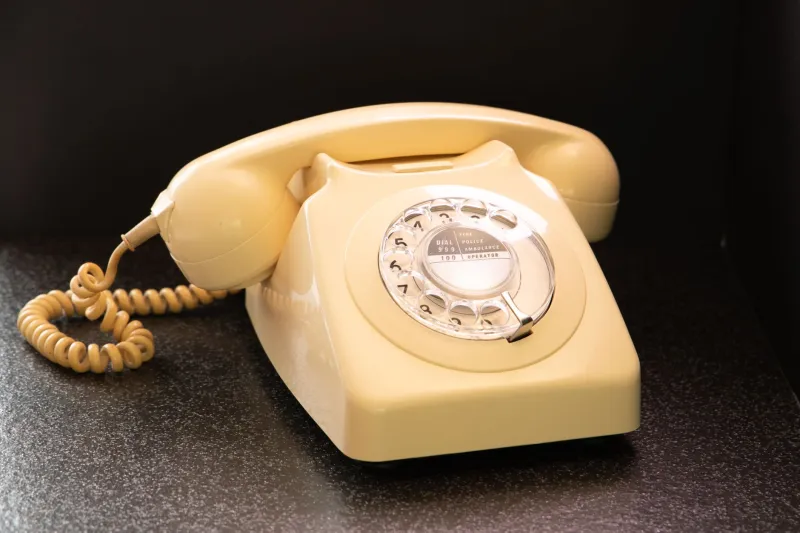
There was also the ritual of the call itself. You dialed — actually rotated a physical dial, which required deliberate, sequential effort. You waited while it rang. You might speak to a parent or sibling first before being passed to the person you actually wanted. These small frictions created psychological space between impulse and action. You couldn't fire off a call the way you'd fire off a text. The act of dialing gave you a few extra seconds to decide whether you really wanted to make it.
For teenagers especially, the phone was the central instrument of social life. Getting access to it was a daily negotiation. Talking on it was performance — you knew your family might overhear, which shaped what you said and how you said it. There was no such thing as a truly private teenage phone call in a house where the phone was in the kitchen.
The Teenager's Dilemma and the Extension Phone
The extension phone — a second handset, usually in a bedroom, connected to the same line — was a luxury that arrived in many American homes during the 1960s and 1970s. For teenagers, it was a revelation. For parents, it was a calculated decision about how much privacy to extend.
But even with an extension, the line was still shared. If your mom picked up the kitchen phone while you were talking, you heard the click. She heard you. The household telephone remained a communal technology, and everyone in the family understood its unwritten rules: keep calls short, don't monopolize the line, and never, ever eavesdrop. (Everyone eavesdropped.)
This shared nature of the phone created a kind of enforced transparency within families. Parents had at least a general awareness of who their children were talking to, simply by proximity. Calls came in on one number. If someone called for your kid, you answered first.
What It Cost to Say Hello From Far Away
Long-distance calling rates tell a particularly stark story about how communication was rationed by economics. In 1960, a three-minute call from New York to Los Angeles cost about $2.50 — roughly $25 in today's money. Calls to family overseas could run $12 or more for a few minutes, which is well over $100 adjusted for inflation.
Families with relatives in other parts of the country communicated primarily by letter. The phone was reserved for genuine news — births, deaths, emergencies, and the occasional birthday. The cost wasn't just financial; it was emotional. Running up the phone bill was a source of real domestic tension in many households.
When long-distance rates began falling in the 1980s following the breakup of AT&T, and then collapsed almost entirely with the arrival of unlimited calling plans in the late 1990s, the change in American communication was profound and immediate.
The End of the Tether
The cordless phone, which became widely affordable in the mid-1980s, was the first step toward liberation. Suddenly you could take a call from the backyard, or pace the living room, or close the bedroom door. The physical constraint of the cord — which had defined telephone use for a century — disappeared almost overnight.
The mobile phone finished the job. By the late 1990s, teenagers were getting their own numbers. By the mid-2000s, the household landline was losing its central role. Today, roughly 70 percent of American adults under 35 live in households with no landline at all.
The telephone didn't just change how we communicate. For most of the twentieth century, it was a shared household resource that shaped family hierarchy, teenage social life, and the economics of long-distance love. The fact that it now lives in your pocket, answering only to you, is a transformation so complete it's easy to forget just how different things were when the whole family shared one number — and one very short cord.