Twenty-Four Exposures and a Prayer: How Film Made Every Family Photo Count
There was a moment — somewhere between your kid blowing out birthday candles and your kid smearing cake across their face — when you had to make a choice. You had maybe three frames left on the roll. You had to pick.
That moment doesn't exist anymore. Today, you just hold down the shutter button and sort through forty near-identical images later. Or never. Mostly never.
But for the better part of a century, photography was an act of intention. And that changed not just how families documented their lives, but how deeply they felt them.
The Economics of the Shutter
A standard roll of 35mm film gave you 24 or 36 exposures. That was it. A family shooting two rolls a month — which was considered fairly active — might generate 48 photographs over 30 days. Each one cost real money. By the 1970s, a roll of Kodak film ran about $2 to $3, and developing it cost another $5 to $8 at your local drugstore or photo lab. In today's dollars, that's roughly $30 to $50 per roll, developed.
So you thought before you clicked. You waited for the right expression. You told your kid to hold still one more time. You framed the shot carefully, because a blurry or poorly composed photo wasn't just disappointing — it was a small financial loss.
This wasn't a burden most families resented. It was simply how photography worked, and it created habits of attention that shaped the way people experienced moments as they happened.
The Week You Had to Wait
Once the roll was finished — and finishing it could take weeks if you weren't a frequent shooter — you'd drop the canister off at a drugstore counter or mail it to a processing lab. Then you waited. Standard turnaround was five to seven days. One-hour photo booths, which started appearing in malls during the 1980s, felt genuinely revolutionary.
That waiting period did something psychologically interesting. It created a second experience of the event. You lived it once in real time, and then you relived it a week later when the prints came back in a small paper envelope. There was anticipation, and there was often surprise — because you'd forgotten exactly what you shot, or the image came out better than you expected, or your kid's expression captured something you hadn't fully noticed in the moment.
Photography was a delayed gift you gave yourself.
The Physical Object That Survived Everything
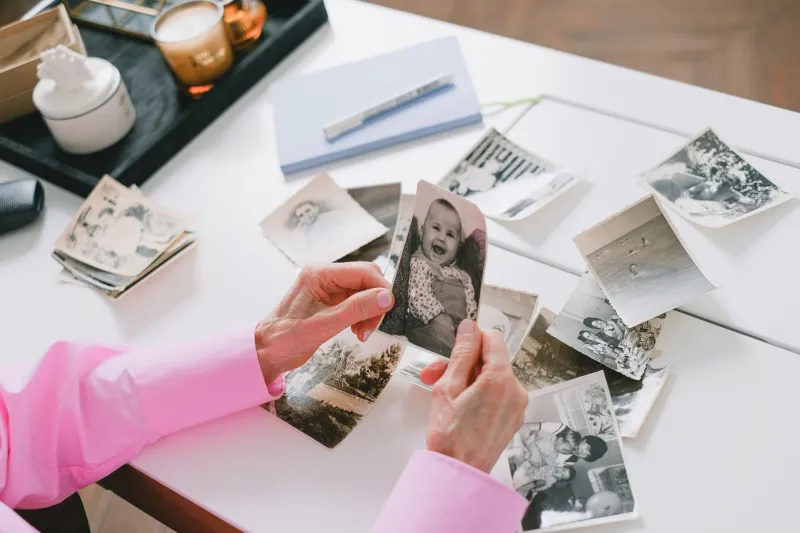
What came out of that envelope was a print — a tangible, holdable thing. It went into a photo album or a shoebox, and it stayed there for decades. Grandparents passed them around at the dinner table. Kids flipped through them on rainy afternoons. They survived house moves, power outages, and the complete collapse of whatever technology had been fashionable the year before.
Those prints had weight. Not just physical weight, though that mattered too — there's something about holding a photograph that looking at a screen simply doesn't replicate. They had emotional weight, because they were finite. A family with three photo albums from the 1960s had three photo albums. Every image in them was chosen. Every image earned its place.
The Paradox of the Infinite Archive
Today, the average American parent takes somewhere between 150 and 200 photos per month on their smartphone. Over the course of a child's first five years, that can add up to more than 10,000 images. Most of them never get printed. Most of them never get organized. A significant portion of them never get looked at again after the day they were taken.
This isn't a criticism — it's just the logical outcome of abundance. When storage is free and the cost of a bad shot is zero, there's no reason to be selective. But something gets lost in that equation.
Research in cognitive psychology suggests that the act of photographing something can actually reduce how well we remember it — a phenomenon sometimes called the "photo-taking impairment effect." When we outsource the memory to the camera, our brains don't encode it as deeply. We were there, technically. But the phone was paying more attention than we were.
Film photographers didn't have that option. They had to be present, because the camera couldn't be everywhere at once.
What Scarcity Taught Families
There's something else worth considering about the old way. Because photographs were scarce, they were curated — not by an algorithm, but by the people who took them. A family's photo album was a genuine editorial statement about what mattered. The images that made it in were the ones that felt worth preserving: first steps, graduations, Sunday dinners, the dog that everyone still misses.
Today, the curation rarely happens. Photos pile up in the cloud, unsorted and unseen. The moments that should be memorable are technically documented but practically lost — buried under thousands of nearly identical frames of the same ordinary Tuesday.
The Print That Still Means Something
Ask anyone over 40 about their most treasured family photographs, and they'll almost certainly describe a physical print. A specific image, in a specific frame, that they could point to in their home right now. Ask someone under 30 the same question, and they'll often pause — then reach for their phone to scroll through thousands of images trying to find the one.
Neither experience is wrong. But they're profoundly different relationships with memory, presence, and what it means to truly see the people you love.
The film era didn't just produce better photographs. It produced people who understood that some moments were worth stopping for — worth framing carefully, worth waiting a week to see. That discipline shaped families in ways we're only beginning to understand now that it's gone.