The Grocery Store Aisle Where You Ran Into Your First Love: Before the Algorithm Brought the Past to Your Phone
The Encounter That Couldn't Be Scheduled
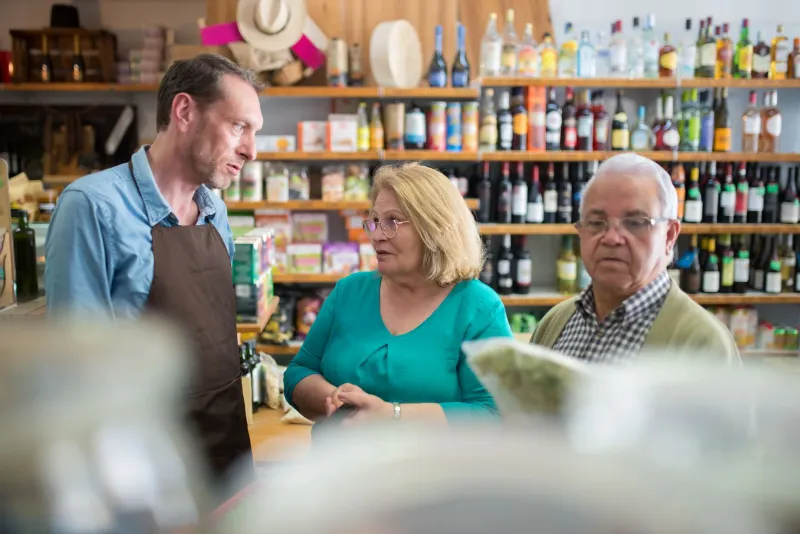
It happened in the cereal aisle, or at the county fair, or at a mutual friend's wedding. You turned a corner and there they were — the person you'd sat next to in homeroom for three years, or the girl you'd taken to prom, or the childhood best friend who moved away in sixth grade and sort of vanished from your life the way people did back then. Your stomach did something. You said their name like a question. And for the next ten minutes, standing in the middle of wherever you were, you caught up on an entire chapter of a life you'd lost track of.
That moment — the accidental reunion — used to be one of the small dramas of American social life. It was random, unscripted, and loaded with a particular kind of emotional weight that's hard to replicate. You hadn't been thinking about them. You hadn't planned this. And yet here you both were, navigating the strange arithmetic of time — how much older you looked, how much was the same, what to say about the years in between.
That moment still happens. But it's rarer now. And the reason is worth thinking about.
How the Past Used to Stay in the Past
For most of the twentieth century, losing touch with someone was easy. You graduated, moved, changed jobs, got married, started over somewhere new — and the people from your previous chapter simply receded. Not because you stopped caring about them, but because there was no infrastructure for staying connected. No feed, no profile, no search bar. If you wanted to find someone, you needed their phone number, a mutual friend who had it, or enough determination to write letters into the void and hope one found them.
High school sweethearts who split up when one of them left for college in another state often stayed split up — not because the feelings evaporated, but because the logistics of reconnection were genuinely difficult. The past had natural barriers. Time and distance did real work.
This meant that the people from your earlier life existed in a particular way in your memory: preserved, a little idealized, and genuinely inaccessible. You could think about them. You could wonder. But you couldn't check. There was no way to see what they looked like now, what they were doing, whether they were happy. The not-knowing was part of the experience of having a past.
What the Algorithm Changed
Facebook launched in 2004. By 2008 or 2009, a significant portion of American adults had profiles. What followed was a mass excavation of the social past. People who had been out of touch for a decade suddenly appeared in each other's feeds. Former classmates, old neighbors, ex-boyfriends and ex-girlfriends — all of them surfaced, not through chance encounters or deliberate effort, but because a platform decided to suggest them.
The People You May Know feature, introduced across various platforms in the late 2000s, was particularly transformative. It used mutual connections, geographic data, and behavioral signals to reconstruct your social network — including the parts you'd left behind. Suddenly, the past wasn't inaccessible. It was one click away, and the platform was actively encouraging you to go there.
This changed something fundamental about how we maintain — or fail to maintain — distance from our histories. Breakups that once had the natural closure of physical separation now had to be actively managed. You had to decide whether to block, unfollow, or simply endure the occasional algorithmic reminder that this person still existed and was apparently doing well. The past, which used to fade, now had to be curated.
The Psychology of Stumbling Versus Searching
There is a meaningful psychological difference between running into someone and being prompted to reconnect with them. The accidental encounter carries a kind of narrative weight — the sense that something larger than your own intentions brought you together, that the universe had a hand in it. It's the stuff of romantic comedies and memoir chapters precisely because it feels meaningful in a way that's hard to engineer.
When an algorithm surfaces someone from your past, the moment is different. You didn't stumble. You were nudged. The platform assessed your social graph, identified a dormant connection, and presented it to you at a moment designed to maximize engagement. That's not fate. That's a recommendation engine.
This doesn't mean the resulting reconnection is without value. People have found genuine friendships, rekindled real relationships, and rebuilt important connections through social media. Those outcomes are real. But the feeling surrounding the reunion — the sense of serendipity, of two lives intersecting against the odds — is largely absent when the platform brokered the introduction.
What We Lost When We Could Always Find Each Other
The inaccessibility of the past served a quiet function in how we constructed identity. The person you were in high school existed in a kind of sealed container — known to the people who were there, but not continuously visible to your present-day life. You could grow away from that version of yourself without it following you. You could become someone different without that earlier self showing up in your suggested connections.
Now, the past is always partially present. Former classmates who knew you at your most awkward are one search away. People who remember a version of you that you've spent twenty years outgrowing can comment on your posts. The algorithm doesn't distinguish between the connections you want to maintain and the ones you quietly let go for good reasons.
There's also something worth noting about what the ease of reconnection has done to nostalgia itself. The ache of wondering what happened to someone — that bittersweet, unresolved feeling — has a shelf life now. You can resolve it in thirty seconds. Which means you often do. And the wondering, which was its own kind of emotional experience, disappears.
The Cereal Aisle Still Exists
The accidental encounter hasn't vanished entirely. People still run into each other at the hardware store and at their kids' soccer games and at the airport gate. Those moments still carry the old charge. But they happen against a backdrop where the past is already largely visible — where you probably already know, at least in outline, what that person has been up to. The encounter is still warm, but the surprise is smaller.
Maybe that's fine. Maybe the convenience of staying connected outweighs the romance of the accidental reunion. But there was something in the not-knowing — in the genuine gap, the real distance, the possibility that someone had become a complete mystery — that made the moment of running into them feel like a small miracle.
And small miracles, it turns out, are harder to manufacture than an algorithm.