The Yellow Envelope at the Door: How America Once Braced for News It Couldn't See Coming
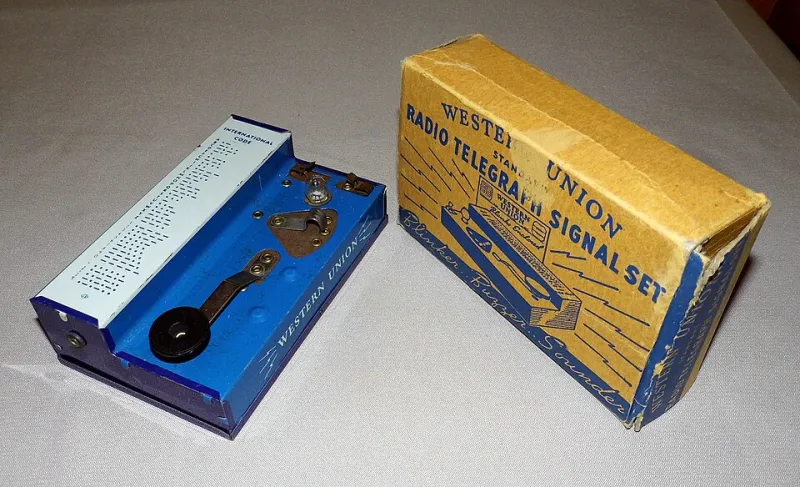
Photo: Joe Haupt from USA, CC BY-SA 2.0, via Wikimedia Commons
Imagine hearing a knock at your front door in the middle of an ordinary Tuesday afternoon. You open it and find a young man in a uniform holding a small yellow envelope. He doesn't need to say anything. You already know that whatever is inside that envelope is going to divide your life into before and after.
For millions of American families throughout the twentieth century, that moment was one of the most emotionally charged experiences a person could have. The Western Union telegram wasn't just a form of communication. It was an event.
 Photo: Western Union, via robots.net
How the Telegram Worked — and Why It Mattered So Much
The telegraph network that made telegrams possible was, for much of American history, the fastest long-distance communication technology that existed. A message could travel from New York to California in minutes — which was genuinely extraordinary at a time when a letter took days or weeks to arrive.
 Photo: New York, via wallpapers.com
But the telegram had a specific social role that went beyond speed. Because sending one cost real money — charged by the word, which is why telegram language became famously terse — people generally didn't send them for casual conversation. You didn't telegram to say hello. You sent a telegram when something had happened. Something significant. An emergency, a death, a birth, a legal matter, a military notification.
That association became so deeply embedded in American culture that the sight of a Western Union messenger approaching your house was enough to trigger genuine dread, regardless of what the message actually contained. The envelope announced its own gravity before it was opened.
The Weight of Waiting
During both World War I and World War II, the telegram took on its most haunting role. Military death notifications were delivered by telegram, and families across America learned to fear the sight of a delivery boy on their street. Neighborhoods watched out for one another — if you saw the messenger stop at a neighbor's house, you went over. You didn't wait to be asked.
There's a particular kind of emotional architecture that builds up around slow, weighted communication. When bad news can only arrive in a specific, recognizable form — when you have to receive it, open it, read it — the moment of knowing is distinct and undeniable. You remember exactly where you were standing. You remember who handed it to you. The physical object becomes inseparable from the memory.
This is genuinely different from how bad news arrives today. A text message, a news alert, a social media post seen while waiting in line for coffee — modern bad news doesn't announce itself. It just appears, mixed in among everything else, leaving no ceremony and very little room to brace.
The Telegram as a Cultural Artifact
Beyond grief and wartime, the telegram wove itself into the texture of ordinary American life in ways that are easy to forget. Business deals were confirmed by telegram. Marriages were proposed. Job offers were extended. The terseness of the format — every unnecessary word cost money — created a kind of compressed, urgent language that had its own poetry. ARRIVING FRIDAY STOP BRING THE CAR STOP LOVE HAROLD.
Western Union at its peak operated more than 20,000 offices across the United States. The company delivered hundreds of millions of messages per year. It employed thousands of bicycle messengers, many of them teenagers, who became as familiar a sight in American towns as the mailman or the milkman.
The telegram also created a new relationship with distance. Before it existed, being far from home meant being genuinely unreachable in urgent moments. The telegram didn't eliminate that distance, but it punched a hole through it. For the first time, a family separated by a thousand miles could know something important within hours rather than weeks.
What Instant Communication Actually Cost Us
Western Union sent its final telegram in 2006. By that point, the service had been functionally obsolete for years, overtaken first by the fax, then by email, then by everything that followed. The idea of paying per word to send a short message seems almost comical now, when communication is effectively free and instantaneous.
But there's a real loss buried in that progress. The deliberateness of telegram communication — the cost, the ceremony, the physical delivery — meant that messages carried weight. If someone spent money to send you a telegram, what they had to say mattered. The medium itself enforced a kind of seriousness.
Today, we receive hundreds of messages a day. Most of them are trivial. The ones that aren't arrive in exactly the same format, through exactly the same channel, with no warning and no ceremony. A text that says call me when you can sits next to a text that says we lost Dad this morning, and there's no yellow envelope, no uniformed messenger, no moment of bracing that tells you which is which before you look.
Then Before Now
The telegram's disappearance is easy to frame as pure progress — faster, cheaper, better. And in most practical ways, that's true. But the emotional texture of American life changed when bad news lost its ceremony. When a knock at the door stopped meaning something. When the weight of a message was no longer announced before it arrived.
The yellow envelope wasn't just slow communication. It was communication that respected the gravity of what it carried. We might not want it back. But understanding what it meant helps explain something about what we've quietly given up in the trade.