Bleacher Seats, Box Scores, and No Replays: A Day at the Ballpark in 1955
Bleacher Seats, Box Scores, and No Replays: A Day at the Ballpark in 1955
It's a Saturday afternoon in August 1955. You're heading to Ebbets Field in Brooklyn to watch the Dodgers. You take the subway — because almost nobody drives to a ballgame in the city — pay a dime for the fare, and walk up to the ticket window maybe twenty minutes before first pitch. No app. No barcode. No presale. You hand over a dollar, possibly two if you want a reserved seat closer to the action, and a man behind a window slides you a paper ticket.
You're in. And what happens next is, by modern standards, almost primitive. It's also, by almost every account from people who were there, kind of wonderful.
Getting There Was Half the Experience
In 1955, most Major League teams played in older urban ballparks built decades earlier — Fenway Park, Wrigley Field, the Polo Grounds, Crosley Field. These weren't suburban stadium complexes surrounded by acres of parking. They were wedged into city neighborhoods, accessible by streetcar, subway, or a short walk from downtown.
That proximity shaped the entire culture around attending a game. Going to the ballpark wasn't a half-day logistical exercise. It was something you did on a Tuesday evening after work or a Sunday afternoon with the kids. The friction was low precisely because the stadiums were woven into the urban fabric rather than isolated from it.
For fans outside the major cities — and remember, in 1955 there were only 16 Major League teams clustered entirely in the Northeast and Midwest — attending a professional game meant an actual trip. The Dodgers wouldn't reach Los Angeles until 1958. If you lived west of St. Louis, you didn't have a home team.
What a Dollar Actually Bought You
Ticket prices in 1955 ranged from roughly $0.75 for general admission bleacher seats to around $2.50 for box seats, depending on the team and the ballpark. Adjusting for inflation, those numbers aren't wildly different from today on their face — but the experience of actually paying them was.
There was no dynamic pricing. No "premium game" surcharges when the Yankees came to town. No service fees tacked on by a ticketing platform. You walked up and paid what the sign said. A family of four could get into a game, buy hot dogs and sodas, and get home having spent the equivalent of what a single upper-deck ticket to a playoff game costs today.
Food inside the park was limited and straightforward. Hot dogs, peanuts, popcorn, and soda were the standard menu. Vendors walked the aisles calling out their offerings. There were no craft beer stands, no sushi bars, no sponsored club lounges with HVAC and televisions showing the same game you came to watch in person.
The Scorecard Was the Technology
Here's the thing that most dramatically separates the 1955 ballpark experience from anything a modern fan encounters: there was almost no broadcast technology in the stands.
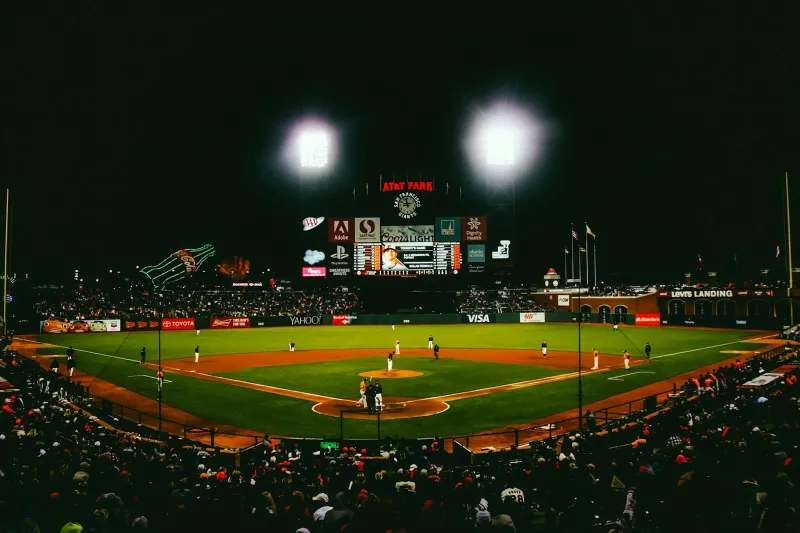
No giant video scoreboard. No instant replay. No in-game statistics crawling across a screen above center field. The scoreboard — and every park had one — showed the score, the inning, and the count. That was largely it. Everything else you wanted to know, you tracked yourself.
This is why the printed scorecard was such a serious part of attending a game. For ten cents, you got a program that listed the rosters and gave you a grid to track every at-bat, every play, every substitution. Scoring a game by hand was a skill that serious fans cultivated and took genuine pride in. It demanded attention in a way that watching a screen-saturated modern game simply doesn't require.
If something happened on the other side of the park and you missed it — a diving catch in left field, a close play at first — you missed it. There was no replay coming. The guy next to you might have seen it. The crowd's reaction was your only real-time commentary.
The Crowd Was Different, Too
Attendance figures at mid-century ballparks were often lower than modern stadiums by raw numbers, but the demographic and cultural texture of the crowd was distinct. Baseball in 1955 was still, unambiguously, the national pastime. The NFL was a secondary concern. The NBA was a fringe sport. Baseball owned summer in a way it no longer does.
Fans came knowing the game deeply. They'd grown up listening to it on the radio — and radio had trained a generation to follow baseball through pure description, building a kind of imaginative fluency with the sport that TV would gradually erode. The crowd at Ebbets Field or Comiskey Park wasn't passive. They were engaged, opinionated, and loud in a very specific, knowledgeable way.
There were also no jumbotron prompts telling them when to cheer.
What Today Looks Like in Comparison
A modern MLB game-day experience is, in almost every material way, more comfortable and more information-rich than anything available in 1955. Tickets purchased weeks in advance through an app, delivered digitally, scanned at a turnstile. Seats with legroom. Concourses with genuine restaurant options. A scoreboard the size of a building showing slow-motion replays, pitcher velocity, launch angle, and sponsored trivia between innings.
Your phone puts every career statistic for every player on the field in your palm in seconds. You can watch a replay of the pitch you just saw live before the next batter steps in. You can order food from your seat and have it delivered.
The average MLB ticket price today sits somewhere between $30 and $350 depending on team, seat, and opponent — and that's before fees, parking, and the $16 beer.
The Thing That Didn't Change — and the Thing That Did
The game itself — ninety feet between bases, sixty feet six inches from mound to plate, three strikes, three outs — is the same game they played at Ebbets Field in 1955. That continuity is part of baseball's particular hold on American culture.
But the ritual surrounding it has been transformed almost completely. The 1955 fan brought a pencil and paid attention. The 2024 fan brings a fully charged phone and a lot of options.
Neither experience is wrong. But only one of them required you to actually watch the game.