Sealed, Stamped, and Meant for You Alone: The Lost Ritual of Saying Thank You by Mail
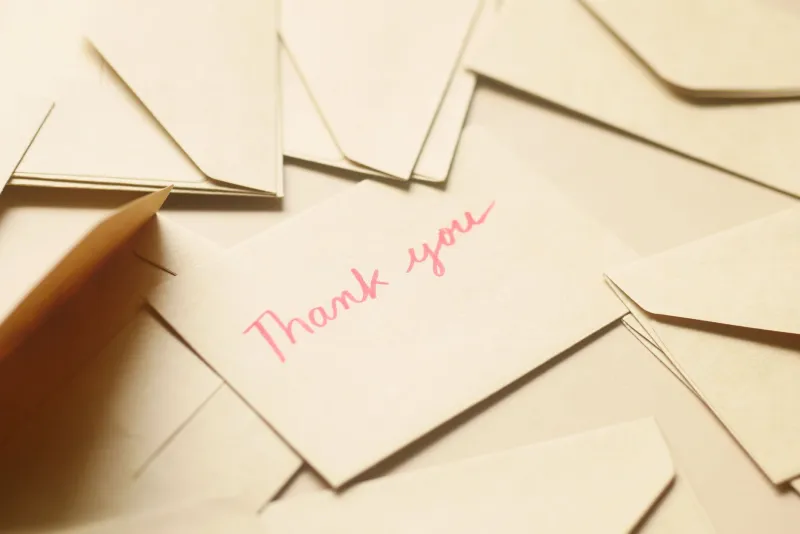
When Gratitude Had a Postmark
Somewhere in a shoebox in a closet — maybe your grandmother's, maybe your mom's — there is almost certainly a small stack of handwritten notes. Cards with flowers on the front. Envelopes addressed in careful cursive. Notes that say things like thank you for the lovely gift or we so appreciated your kindness during a difficult time. They were kept not because the words were extraordinary, but because someone took the time to write them down and mail them. That effort meant something. It still does.
For most of American social life through the twentieth century, the thank-you note was not optional. It was an expectation — woven into etiquette books, enforced by mothers, and understood as the minimum requirement for being considered a thoughtful person. You got a wedding gift, you wrote a note. You stayed at someone's house for the weekend, you wrote a note. A teacher went out of her way for you, you wrote a note. And you did it on paper, in ink, with your actual handwriting, because that was simply how it was done.
What It Actually Cost You
The process sounds simple, but it required something modern convenience has largely eliminated: deliberate effort. You needed stationery — which meant either buying it or having a supply on hand. You needed a working pen. You needed a stamp, which meant either having a book of them in a drawer or making a trip to the post office. You needed to sit down, think about what you wanted to say, and commit it to paper without the ability to delete or unsend.
And then you waited. The note went into the mail, rode through a sorting facility, traveled across however many miles, and arrived — sometimes three days later, sometimes three weeks, depending on distance and luck. The recipient held something physical. Something you had touched. Something that had taken a small but real journey to reach them.
That journey was part of the meaning.
There is a reason people kept those notes. You don't keep a text message in a shoebox. You don't frame an emoji. But handwritten letters from people who are no longer alive become precious objects — proof that someone once sat down, thought of you specifically, and made the effort to say so in a way that could survive them.
The Shift to Instant
At some point in the 1990s and early 2000s, email started absorbing a portion of thank-you correspondence. It was faster, it was easier, and it still required actual sentences — so it retained some of the intentionality of the written note. Then came texting. Then social media. Then reaction buttons. Today, a gift can arrive, be photographed for Instagram, and earn a heart emoji — all within the same afternoon. Gratitude has become frictionless.
That frictionlessness is genuinely useful. Nobody is arguing that speed is inherently bad. If you want to thank your friend for picking up your kids in a pinch, a quick you're a lifesaver, thank you so much text gets the job done, and it gets it done immediately. There's warmth in that. There's ease in that. And for the busy, stretched-thin reality of modern American life, ease matters.
But something shifted in the texture of gratitude when the effort required to express it dropped to nearly zero. When saying thank you costs you nothing — no time, no stationery, no trip to the mailbox — it becomes harder for the recipient to measure what they meant to you. The signal gets diluted. A hundred thank-you texts in a year carries less weight than twelve carefully written notes, not because the words are different, but because the investment is.
What the Note Was Really Saying
Here's the thing about the handwritten thank-you note that doesn't get discussed enough: it wasn't really about gratitude in the abstract. It was about specificity. The best ones named the thing you were grateful for, described why it mattered, and said something personal. The blue sweater fits perfectly and I wore it on Christmas morning. Your help moving the furniture made a completely overwhelming weekend feel manageable. Those details required you to actually think — to revisit the moment, to articulate its value, to be present in the act of remembering.
That process had a side effect nobody talks about: it was good for you. Psychologists who study gratitude have found consistently that the act of articulating thanks — in detail, in writing — produces measurable improvements in mood, relationship satisfaction, and sense of connection. The note wasn't just good manners. It was, in a very real sense, a mental health practice dressed up as etiquette.
The Thing That Didn't Survive the Upgrade
We traded permanence for speed. We traded specificity for convenience. And we traded the small, meaningful signal of I sat down and thought about you for something faster that carries less of that signal, even when the feeling behind it is just as real.
None of this means you should feel guilty for texting your thank-yous. But it might be worth asking, once in a while, whether the person on the receiving end deserves the slower version. Whether the occasion is big enough to earn a stamp. Whether the relationship is important enough to sit down with a pen.
Somewhere in a store near you, there is a card with flowers on the front. It costs about four dollars. A stamp costs sixty-eight cents. And the person who opens it three days from now might just keep it in a shoebox for the next thirty years.
That's a pretty good return on five dollars.