He Knew Your Father's Heart History Before He Checked Your Blood Pressure: The Slow Death of the Family Doctor
Somewhere in the back of a filing cabinet in a small-town Ohio practice, circa 1967, was a manila folder stuffed with handwritten notes. The doctor who kept it had delivered the patient inside it, treated his childhood ear infections, set his broken wrist after a fall from a barn roof, and quietly counseled his parents through a miscarriage they never talked about publicly. That folder wasn't just a medical record. It was a biography.
Ask most Americans under 40 to describe their primary care physician and you'll get something more like this: rushed, distracted, eyes mostly fixed on a screen, gone before you've finished your second question. The appointment was booked six weeks out, lasted eleven minutes, and ended with a referral to someone you've never met.
Both descriptions are true. And the distance between them tells you something important about what American medicine traded away in the name of efficiency.
The Appointment That Wasn't Timed
In the mid-twentieth century, the family doctor wasn't just a medical professional — he was a fixture of the community. He attended the same church, knew your employer, and had probably treated three generations of your family. That social embeddedness wasn't incidental to the medicine. It was the medicine.
Diagnosis in that era relied heavily on conversation. Before lab panels and imaging technology became routine, a doctor's primary tool was the patient interview. He asked about stress at work, changes in appetite, how you were sleeping, whether your father had died young. He listened for things you hadn't thought to mention. A good family doctor in 1955 could build a remarkably complete clinical picture from a twenty-minute conversation and a careful physical exam.
He also had something modern medicine has largely dismantled: continuity. The same physician who treated your strep throat in February was the one who noticed, three years later, that your blood pressure was creeping up in a pattern that matched your father's before his first heart attack. That longitudinal knowledge — the kind you can only accumulate across years — was genuinely diagnostic. It caught things that a snapshot appointment never would.
The System That Changed Everything
The shift didn't happen overnight, and it wasn't driven by doctors who stopped caring. It was driven by money, logistics, and the scale of modern healthcare.
As health insurance became the dominant payment model through the 1970s and 80s, medical practices began operating under reimbursement structures that rewarded volume. Seeing twelve patients a day paid better than seeing six deeply. Ordering a test was often more defensible — legally and financially — than relying on clinical judgment built over years. Malpractice concerns pushed documentation to the center of every encounter. The paperwork multiplied. The conversation shrank.
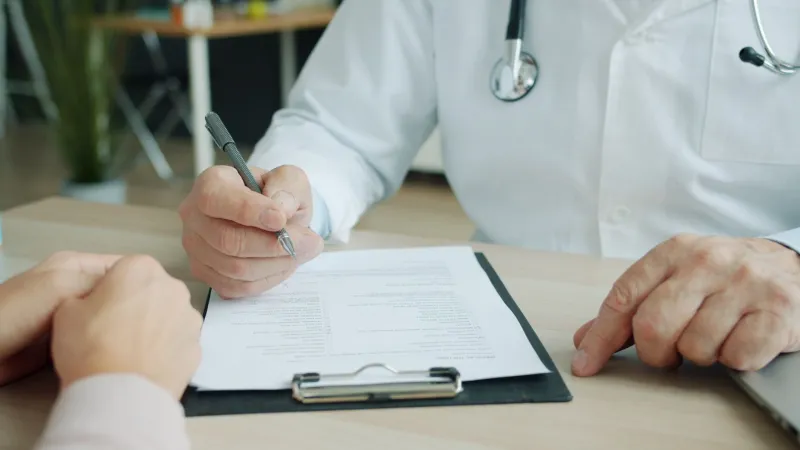
By the time electronic health records became mandatory under the Affordable Care Act's incentive programs in the early 2010s, many physicians were spending more time entering data than examining patients. Studies have suggested that primary care doctors now spend nearly half of their working hours on administrative tasks. The average office visit runs somewhere between 15 and 18 minutes. A significant portion of that is the doctor's back turned to you while they type.
Specialization deepened the fragmentation further. Where a family doctor once managed most of your health across a lifetime, today's patient might see a cardiologist, an endocrinologist, a gastroenterologist, and a dermatologist — none of whom necessarily talk to each other, and none of whom know that your anxiety spikes every fall or that your father dropped dead at 58.
What the Clipboard Costs You
There are real gains in modern medicine that shouldn't be minimized. The diagnostic tools available today are extraordinary. A condition that would have gone undetected — or been misattributed — in 1965 can now be identified with a blood draw and a scan. Evidence-based treatment protocols have standardized care in ways that reduce the influence of individual physician bias. Telemedicine has made basic consultations accessible to people in rural areas who once had to drive two hours for a follow-up.
But there are losses worth naming honestly.
Patients today frequently report feeling like they haven't been heard. Studies consistently show that doctors interrupt patients within the first eleven seconds of them describing their symptoms. The diagnostic conversation — the unhurried back-and-forth that once surfaced the real story — has been compressed into a symptom checklist and a billing code. What gets lost in that compression isn't just bedside manner. Sometimes it's the actual diagnosis.
There's also the matter of trust. The old family doctor relationship created something that's genuinely hard to replicate algorithmically: a patient who told the truth. When your doctor had known you for fifteen years, you were more likely to admit that you hadn't been taking your medication, that you'd been drinking more than you let on, that the chest tightness had been there for three months before you mentioned it. That candor saved lives. It's harder to be that honest with someone you've met twice.
The Folder That Knew You
There's a version of the future where technology closes some of this gap. Integrated health records that follow you across providers, AI tools that surface patterns across years of data, longer appointment models built around preventive care — these exist in pockets, and some are genuinely promising.
But the manila folder in that Ohio filing cabinet held something that no algorithm has quite replicated: the sense that the person reading it actually knew you. Not your metrics. You.
Medicine got faster and in many ways better. What it hasn't yet figured out is how to also stay close.