Your Money Was Locked Up and the Bank Closed at Three: Personal Finance Before the Digital Age
Your Money Was Locked Up and the Bank Closed at Three: Personal Finance Before the Digital Age
It's Friday afternoon, sometime in the fall of 1965. You're a working American — maybe a factory floor supervisor in Detroit, maybe a schoolteacher in Ohio, maybe a small business owner in suburban Atlanta. You've got a paycheck in your hand, a grocery run ahead of you this weekend, and a phone bill sitting on the kitchen counter that needs to be paid by Monday.
Here's your problem: it's 3:15pm, and the bank closed fifteen minutes ago.
This was not an unusual situation. This was Tuesday. This was life.
Banking Hours Were Non-Negotiable
The phrase "banker's hours" didn't become a cultural shorthand for cushy, abbreviated work schedules by accident. Through most of the 1960s, the standard operating hours for an American bank branch were roughly 9am to 3pm, Monday through Friday. Some branches extended to 5pm on Fridays. Saturdays were hit or miss, and Sunday was simply not a concept that banking entertained.
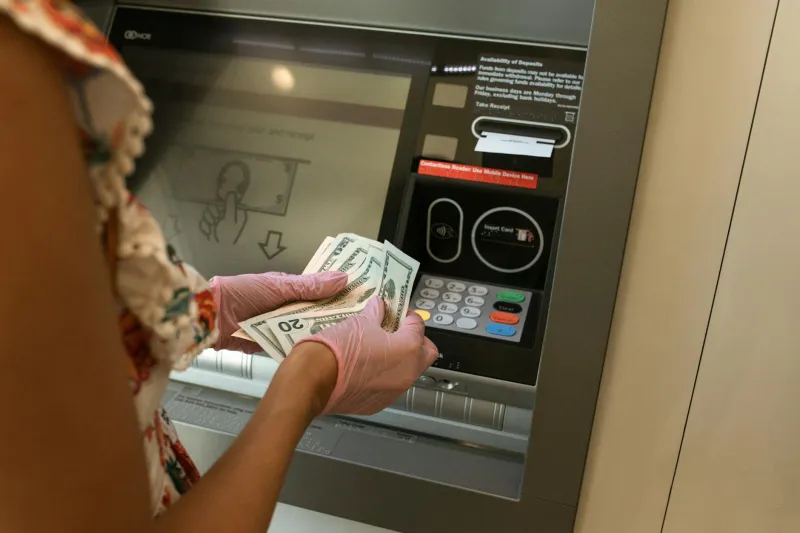
If you needed to deposit a check, withdraw cash, or handle virtually any financial transaction, you arranged your life around those hours or you waited. There was no alternative infrastructure. ATMs didn't arrive in the US in any meaningful way until the early 1970s, and even then their rollout was slow and their acceptance uneven. The first true nationwide ATM network didn't exist until the 1980s.
For most Americans in 1965, the bank branch was the only point of contact between them and their money. Full stop.
Cashing a Check Was a Social Transaction
Direct deposit — the system by which your employer now wires your paycheck directly into your account on payday — didn't become widespread until the 1970s and 1980s. Before that, most workers received a physical check, which then had to be physically presented to a bank or check-cashing establishment to become usable money.
At many smaller banks and credit unions, this process had a distinctly personal dimension. Tellers frequently recognized regular customers by face and name. In some cases, that recognition was functionally your security credential. Your signature on file was compared to the one you wrote in front of them — that was the authentication system. No PIN, no two-factor verification, no fraud alert to your phone. A matching signature and a familiar face.
This worked reasonably well for established customers at their home branch. It created immediate complications if you tried to cash a check anywhere else. Walk into an unfamiliar branch — let alone a bank you didn't have an account with — and you were likely to be turned away or charged a fee. The concept of your money being universally accessible was not yet a feature of American financial life.
Paying Bills Required Envelopes and Stamps
Monthly bills — utilities, the phone company, the mortgage, the car payment — were paid by mailing a paper check. This sounds straightforward until you map out the actual workflow.
You received a paper bill in the mail. You wrote a check, which meant you needed a sufficient balance in your checking account and the discipline to track that balance yourself in a paper register. You put the check in the return envelope included with the bill, added a stamp, and mailed it back — leaving enough time before the due date for the mail to actually arrive and the payment to be processed.
Getting that timing wrong had real consequences. A late payment wasn't flagged digitally and resolved with a phone call. It generated a paper late notice, sometimes a fee, and in some cases a service interruption. Overdrawing your checking account because you lost track of outstanding checks was a genuine and common financial hazard, since there was no app showing you a real-time balance.
Some households kept meticulous paper ledgers. Others ran on approximation and hope.
The Weekend Cash Problem
Here's a scenario that will feel genuinely alien to anyone who came of age in the smartphone era: it's Saturday morning, you have no cash, and you need to buy groceries.
In 1965, this was a problem with very few solutions. Your bank is closed. There is no ATM on the corner. Your debit card does not exist — the first bank debit cards didn't appear until the mid-1960s and weren't widely adopted for years after that. Credit cards existed, but were not universally accepted, particularly at grocery stores and small retailers who were still operating largely on a cash basis.
Your options were roughly these: borrow cash from a neighbor or family member, put the groceries on a store charge account if your local grocer offered one, or simply wait until Monday. Many Americans kept a designated "emergency cash" envelope at home precisely because the financial system had a hard stop every Friday afternoon.
Running out of money over a holiday weekend — say, a long Fourth of July — wasn't a mild inconvenience. It was a real planning failure with real consequences.
What Changed Everything
The transformation didn't happen overnight. It came in stages over roughly three decades.
ATMs began appearing in US cities in the early 1970s — Citibank's aggressive ATM rollout in New York during a 1978 blizzard is often credited with convincing a skeptical public that the machines were actually useful. Interbank ATM networks expanded through the 1980s, making it possible to use your card at machines your bank didn't own. Debit cards tied directly to checking accounts became standard issue through the late 1980s and 1990s. Online banking arrived in the mid-1990s, and mobile banking in the late 2000s completed the transformation.
By the time the iPhone launched in 2007, the idea of being unable to access your money on a Sunday afternoon was already becoming a story people told their kids.
The Distance Between Then and Now
Today, the average American can check their account balance at 2am, transfer money between accounts in seconds, deposit a check by photographing it, pay every bill automatically without writing a single check, and withdraw cash from tens of thousands of ATM locations across the country.
The friction that defined everyday personal finance in 1965 — the limited hours, the geographic dependency, the paper-based systems, the weekend cash problem — has been almost entirely engineered away. What remains feels almost nostalgic: the occasional checkbook pulled out to pay rent, the paper statement that still arrives in some mailboxes.
In 1965, your money was yours — but the bank decided when you could have it. That arrangement lasted for generations, and most people simply built their lives around it.
It took a few machines and a couple of decades to make the whole thing feel like a distant memory.