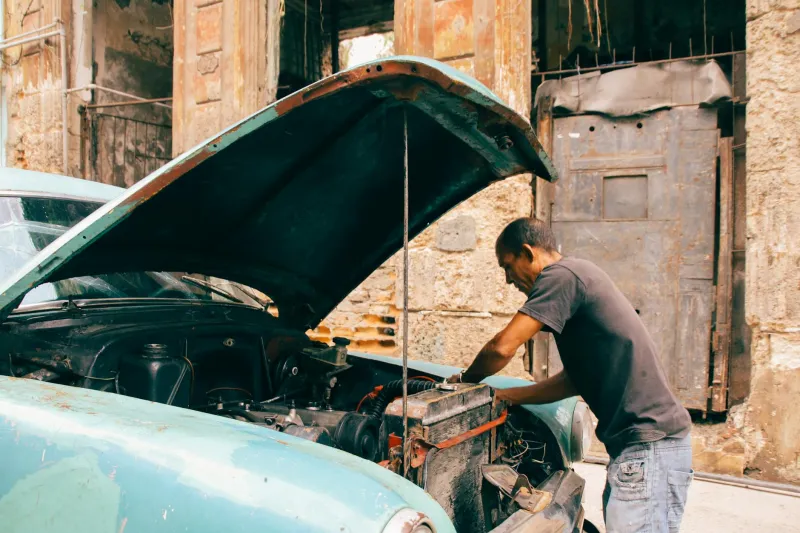
Pop the hood of a modern car, and you'll find a maze of plastic covers hiding everything important. Warning labels threaten dire consequences for touching anything. Even checking the oil requires consulting an owner's manual. This sterile, hands-off relationship between Americans and their vehicles would have baffled previous generations who considered basic car maintenance as essential as knowing how to tie your shoes.
The Backyard Mechanic Era
In 1975, Saturday mornings across America sounded like a symphony of socket wrenches and revving engines. Suburban driveways doubled as repair shops where fathers taught sons (and occasionally daughters) the mysteries of internal combustion. A basic tool kit, a Chilton's repair manual, and weekend afternoon could solve most automotive problems.
Cars were mechanical creatures you could understand by looking at them. Carburetors mixed air and fuel in ways that made intuitive sense. Distributors and points controlled ignition timing through simple mechanical principles. When something broke, you could usually see what was wrong and fix it with parts from the local auto store.
The neighborhood mechanic wasn't a computer technician—he was a guy named Dave or Mike who'd learned his trade through apprenticeship and experience. His garage smelled like motor oil and coffee, and he could diagnose most problems just by listening to your engine. Parts were interchangeable, rebuilt components were common, and labor costs reflected the relatively simple nature of automotive repair.
When Cars Had Personalities
Every car had quirks that owners learned to accommodate. Your Chevy might need an extra pump of the gas pedal on cold mornings. Your Ford might require jiggling the key in a particular way. These weren't flaws—they were personality traits that created genuine relationships between people and their vehicles.
Owners developed intimate knowledge of their cars' sounds, smells, and behaviors. They knew when something was wrong long before a dashboard warning light appeared. This connection fostered a sense of mechanical empathy that made troubleshooting feel natural rather than mysterious.
Car culture thrived on this accessibility. Hot rod enthusiasts could modify engines with hand tools and imagination. Racing teams consisted of friends with more enthusiasm than budget, building competitive machines in garage workshops. The barrier between driver and mechanic was low enough that most people crossed it regularly.
The Digital Revolution
The transformation began in the 1980s as emissions regulations demanded more precise engine control than mechanical systems could provide. Electronic fuel injection replaced carburetors. Computer modules began managing ignition timing, transmission shifting, and emissions control. These changes improved reliability and performance dramatically, but they also created a new class of problems that couldn't be solved with traditional tools.
By the 1990s, cars required specialized diagnostic equipment to communicate with their internal computers. Error codes replaced obvious mechanical symptoms. A rough idle might indicate anything from a faulty sensor to corrupted software, and determining the difference required expensive scan tools and technical training that most backyard mechanics couldn't afford.
Manufacturers began designing cars specifically to discourage owner maintenance. Oil change intervals stretched from 3,000 to 10,000 miles, making regular under-hood inspections less common. Sealed components eliminated adjustment points that once required periodic attention. Warning lights replaced gauges that once gave drivers continuous feedback about their car's condition.
The Sealed Box Era
Today's cars are marvels of engineering reliability, but they've become essentially sealed boxes that reveal nothing about their internal workings. Plastic engine covers hide everything interesting. Specialized fluids replace simple motor oil and coolant. Even basic maintenance like changing air filters often requires removing multiple plastic panels and following complex procedures.
Modern diagnostic systems can pinpoint problems with incredible precision, but only for technicians with the right equipment and training. A simple sensor failure might trigger a cascade of error codes that makes the underlying problem nearly impossible to identify without professional help. Software updates and module programming have become routine parts of automotive repair.
The neighborhood mechanic has largely disappeared, replaced by dealership service departments and chain repair shops staffed by technicians who specialize in specific brands or systems. Independent shops struggle to afford the constantly updated diagnostic equipment and training required to service modern vehicles.
What We Gained and Lost
Modern cars are undeniably better in almost every measurable way. They're safer, more efficient, more reliable, and cleaner than their predecessors. A typical car today will run 200,000 miles with minimal maintenance, while cars from the 1970s required constant attention just to reach 100,000 miles.
But something intangible was lost in this transformation. The connection between Americans and their cars has become purely transactional. Cars have evolved from mechanical partners that required understanding and care into appliances that simply work until they don't. When problems occur, owners feel helpless rather than curious.
The death of backyard mechanics also eliminated an important pathway for learning practical problem-solving skills. Working on cars taught generations of Americans how mechanical systems functioned, how to diagnose problems systematically, and how to fix things with their hands. These skills transferred to other areas of life, creating a culture of self-reliance and mechanical confidence.
The Right to Repair
A growing movement advocates for "right to repair" legislation that would require manufacturers to provide independent mechanics and car owners access to diagnostic information and repair procedures. This reflects a broader recognition that the trend toward sealed, proprietary systems may have gone too far.
Some manufacturers have begun acknowledging this concern. A few companies now offer simplified diagnostic tools for basic troubleshooting, and some have designed more accessible engine bays that allow easier maintenance access.
Looking Under the Hood Again
The era of the backyard mechanic isn't coming back—modern cars are simply too complex for casual tinkering. But perhaps there's middle ground between the sealed-box approach and the old days when everything required constant adjustment.
Young Americans interested in automotive culture increasingly focus on older, simpler cars that can still be understood and modified with basic tools. This "analog car" movement represents a desire to maintain some connection with the mechanical world that modern technology has largely hidden from view.
The relationship between Americans and their cars will continue evolving as electric vehicles and autonomous systems reshape the automotive landscape. But the memory of when cars were partners rather than appliances serves as a reminder that sometimes progress means losing something valuable along with gaining something new.