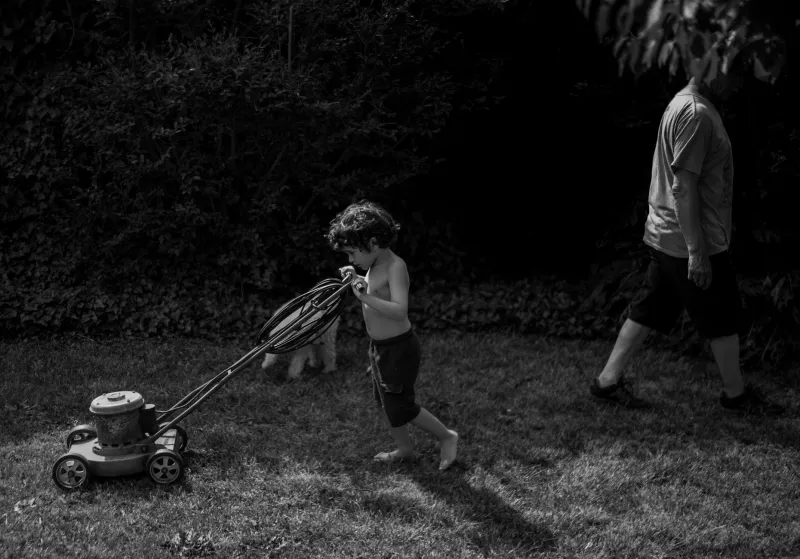
In 1978, fourteen-year-old Mike Richardson owned three lawn mowers, employed two younger kids, and maintained steady contracts with eighteen houses in his Sacramento neighborhood. Every Saturday morning, his small crew would fan out across suburban streets, transforming overgrown yards into pristine lawns. By Sunday evening, Mike had collected roughly $60—equivalent to about $280 today—enough to cover his school clothes, movie tickets, and gas money for weekend adventures.
Mike wasn't unusual. He was part of an entire shadow economy of American teenagers who funded their lives through paper routes, babysitting gigs, snow shoveling, and odd jobs. This informal network of teen entrepreneurs didn't just provide spending money—it created an entire generation's first understanding of work, money, and independence.
The Paper Route Empire
Before the internet killed local newspapers, the paper route was America's entry-level job. Nearly every neighborhood had at least one kid who woke before dawn, loaded their bike with rolled newspapers, and delivered the morning news to dozens of subscribers. The work was reliable, the pay steady, and the business lessons invaluable.
Twelve-year-old carriers learned customer service when Mrs. Henderson complained about wet newspapers. They discovered cash flow management when collection day determined whether they could afford new baseball cards. They understood profit margins when deciding whether to expand their route or hire a substitute for vacation.
 Photo: Mrs. Henderson, via assets.playbill.com
A typical paper route in 1970 served 40-60 customers and generated $15-25 weekly—roughly $100-165 in today's money. Ambitious kids worked multiple routes or convinced friends to share larger territories. The best carriers built genuine businesses, complete with customer relationships, quality standards, and growth strategies.
Suburban Lawn Care Moguls
Lawn mowing was the summer gold mine for teenage boys across suburban America. Armed with a borrowed mower and door-to-door sales skills, kids as young as twelve built client lists that funded their entire warm-weather lifestyle. The work was straightforward: show up weekly, cut grass, collect payment, repeat.
What made the lawn care economy work was trust and simplicity. Homeowners didn't require insurance certificates, background checks, or business licenses. They judged teenage mowers on results: Did the grass look good? Did the kid show up consistently? Was the price fair? Success bred referrals, and referrals built empires.
Smart teenage mowers learned business fundamentals that many adults never master. They discovered pricing strategy when competing with professional services. They understood customer retention when deciding whether to raise rates. They learned operational efficiency when figuring out how many lawns they could handle in a single day.
The Babysitting Network
Teenage girls dominated the babysitting economy, but it was more sophisticated than most adults realized. Successful babysitters maintained detailed networks of families, coordinated schedules with friends, and built reputations that commanded premium rates. The best sitters were booked weeks in advance for weekend evenings and commanded $2-3 hourly in the 1970s—$12-18 today.
Babysitting taught skills that formal jobs rarely provided: crisis management when toddlers had meltdowns, negotiation when kids refused bedtime, and customer service when parents returned home to happy children and spotless houses. The work required maturity, responsibility, and emotional intelligence that many teenagers developed nowhere else.
The babysitting economy also created its own social hierarchy. Popular sitters built waiting lists and could be selective about families. They learned to handle difficult children, manage emergencies, and maintain professional relationships with adults who viewed them as essential household help.
When Teenagers Had Real Purchasing Power
The cumulative effect of this teenage economy was remarkable: most American kids had genuine spending money earned through their own effort. A typical teenager in 1975 might earn $20-40 weekly through various jobs—$95-190 in today's dollars. That income funded clothes shopping, entertainment, car expenses, and social activities without requiring parental subsidies.
Teenagers bought their own concert tickets, paid for dates, and saved for cars. Many contributed to family expenses or funded their own school supplies. The experience of earning, spending, and saving money created financial literacy that formal education rarely provided.
More importantly, teenage work created independence. Kids learned that effort generated income, that income enabled choices, and that choices had consequences. The connection between work and reward was immediate and personal.
The Great Disappearance
Today's teenagers face a fundamentally different landscape. Newspaper delivery has been replaced by adult drivers covering massive routes. Lawn care requires insurance, equipment, and transportation that most teenagers can't access. Babysitting competes with professional childcare services and requires certifications that didn't exist in 1975.
Liability concerns have eliminated most casual teen employment. Homeowners worry about insurance coverage if teenage workers get injured. Parents fear legal responsibility for their children's business activities. Simple handshake agreements have been replaced by complex contracts that few teenagers can navigate.
The result is a generation of teenagers with dramatically less work experience and financial independence. Instead of learning business skills through paper routes and lawn care, they focus on academic achievement and structured activities that rarely involve money management or customer relationships.
What We Lost Along the Way
The disappearance of teenage work has created unexpected consequences. Modern teenagers often reach college with limited understanding of basic financial concepts. They've never experienced the satisfaction of building a customer base or the disappointment of losing clients due to poor service. They've never learned that showing up consistently, working hard, and treating customers well generates sustainable income.
Perhaps most significantly, they've never experienced true financial independence. The teenager who earned $30 weekly mowing lawns in 1975 controlled their own money and made their own spending decisions. Today's teenagers typically receive allowances or rely on parents for discretionary spending, creating dependency rather than independence.
The informal teenage economy wasn't just about money—it was about growing up. Kids learned responsibility, developed work ethic, and gained confidence through small business success. They discovered that they could create value, solve problems, and earn respect through effort and reliability.
That world is gone, replaced by structured activities and academic pressure that rarely teach the practical skills of work and money. We've gained safety and lost something harder to measure: the confidence that comes from knowing you can take care of yourself, one lawn at a time.